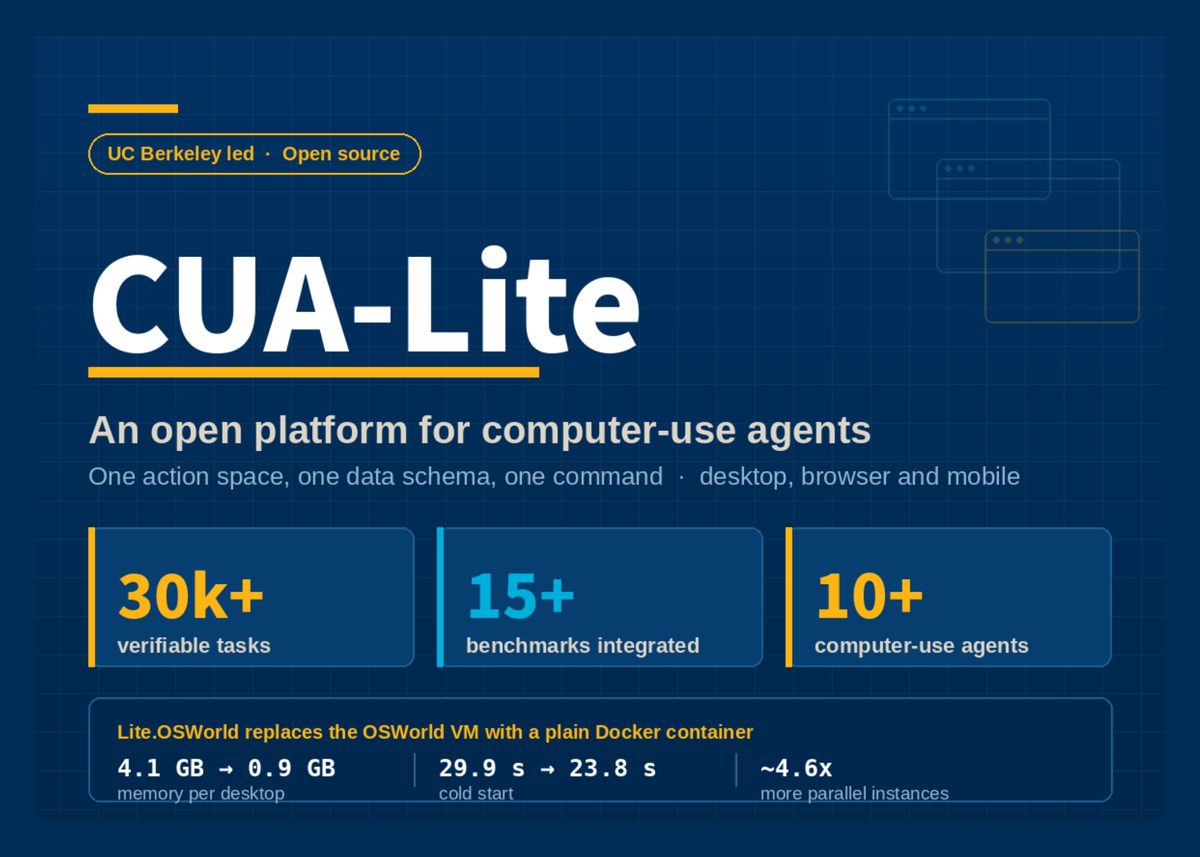
UC Berkeley researchers have released CUA-Lite, an open-source infrastructure platform designed to consolidate computer-use agent (CUA) training, data, evaluation, and reinforcement learning. The project addresses the fragmentation across current agent repositories by unifying desktop, browser, and mobile environments under a single action space, command line, and data schema. Instead of relying on full virtual machines that require nested virtualization, CUA-Lite utilizes lightweight Docker containers, providing tools like Lite.OSWorld that match full VM benchmark fidelity while running on standard cloud instances.
The platform introduces LiteSample, a standardized supervised-learning schema shipped as Parquet files and images. Ten existing CUA datasets have been converted to this format and published on Hugging Face, alongside synthetic rollout datasets generated by frontier teacher models. CUA-Lite also includes adapters for fine-tuning models like Qwen3-VL and running reinforcement learning updates using GRPO on top of Slime.
By simplifying environment orchestration, CUA-Lite removes significant infrastructure barriers for teams developing multimodal computer-use capabilities. The standardized data format and execution loop allow developers to easily swap models and environments, streamlining both supervised fine-tuning and reinforcement learning pipelines for desktop, web, and mobile agents.
Why it matters
Eliminates QEMU/KVM hardware requirements by enabling OS-level computer agent evaluation inside standard Docker containers on cloud instances.
Standardizes fragmented computer-use datasets into a unified Parquet format (LiteSample), reducing data engineering overhead for multimodal training.
Provides out-of-the-box support for 10+ agent architectures and 15+ benchmark suites spanning desktop, browser, and mobile interfaces.
Source: marktechpost.com