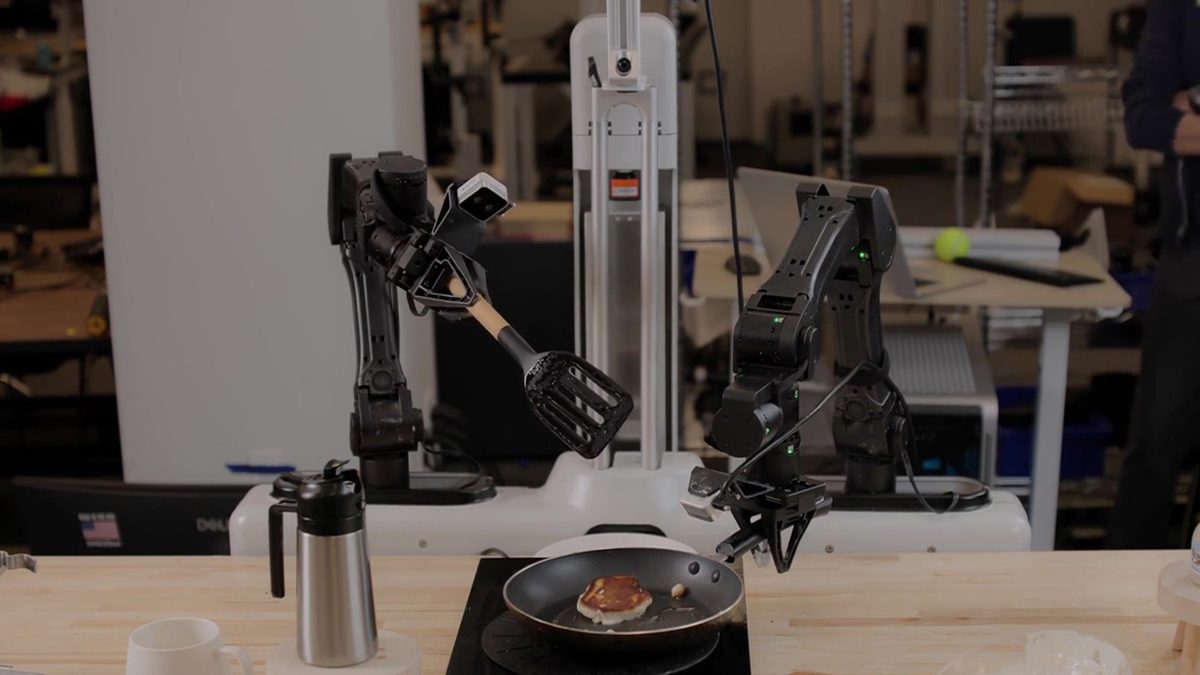
Robotics startup Skild AI has launched its S1 robot foundation model, developed on NVIDIA AI infrastructure to enable robots to learn unseen, multi-step tasks from a single video demonstration. Using in-context learning, the model interprets video prompts and translates them into physical actions without updating its weights or requiring task-specific post-training. Skild AI also reported reaching a $100 million annual revenue run rate 10 months after its initial commercial deployment.
The S1 model can perform unfamiliar physical tasks lasting up to 10 minutes—such as kit assembly, pour-over coffee brewing, and plant potting—achieving a 66% step success rate in tests compared to 9% for baseline systems. Skild estimates one video example provides learning value equivalent to roughly 380 manual training runs. Skild, NVIDIA, and Foxconn are currently deploying the technology on dual-arm manipulators for high-precision assembly of NVIDIA Blackwell systems.
Why it matters
In-context learning via video prompts drastically reduces robotics deployment cycles by removing the need for task-specific dataset collection and fine-tuning.
Adaptable physical AI models enable dynamic factory retooling, allowing hardware operators to introduce new processes without costly reprogramming.
Rapid commercial traction in physical AI signals maturing enterprise adoption for flexible, non-preprogrammed robotic foundation models.
Source: blogs.nvidia.com