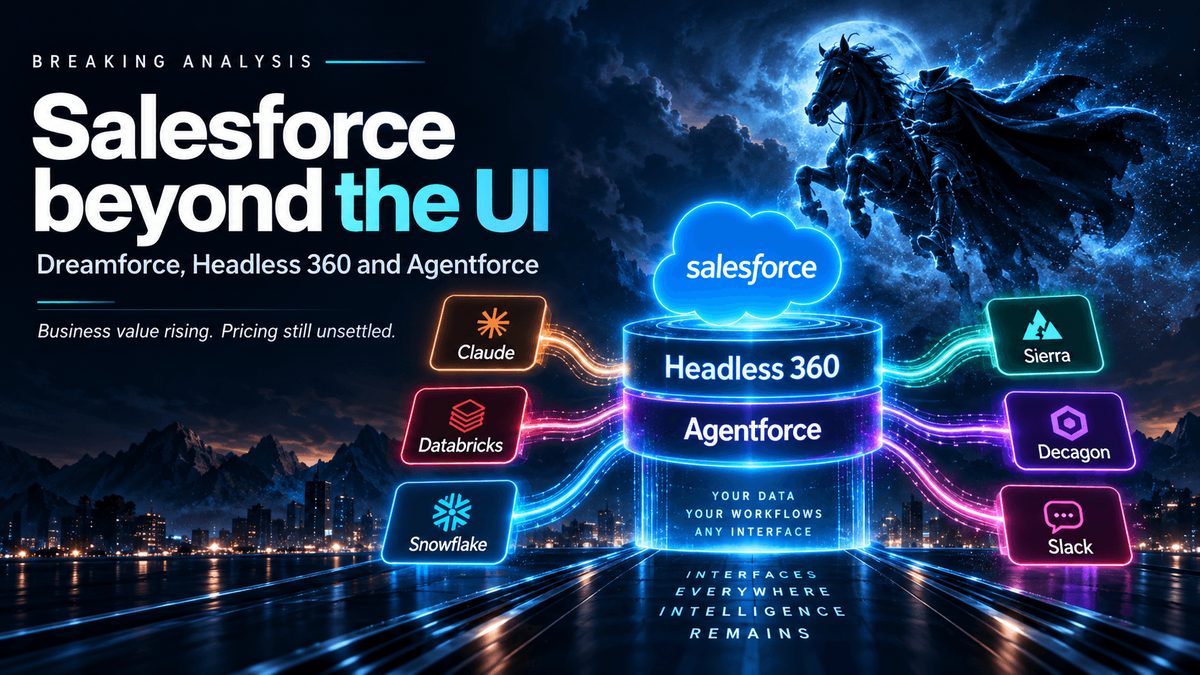
Salesforce Inc. is confronting a fundamental shift in enterprise software usability following Dreamforce 2026, as AI agents increasingly execute tasks across external interfaces like Slack or Claude rather than inside the traditional CRM application. Research from Qualitate indicates that while most surveyed organizations remain in Agentforce pilots, 75% of customers who have modeled the financial impact of headless access expect their Salesforce spending to increase rather than decline.
To capture this shift, Salesforce is pitching an enterprise AI harness that connects data, business knowledge, workflows, and governance controls across disparate systems. This approach combines deterministic enterprise software with stochastic large language models, allowing AI agents to generate dynamic interfaces tailored to specific tasks outside Salesforce’s native screens.
The strategic transition poses pricing and retention challenges for the company. As user engagement migrates to third-party AI environments, Salesforce must justify the value of its underlying system of intelligence and context capabilities to maintain software seat value and prevent customer churn to AI-native alternatives.
Why it matters
SaaS founders must architect products for headless execution, as enterprise users shift from fixed UIs to AI-generated task workflows.
Enterprise buyers should re-evaluate pricing models, moving from seat-based licenses to consumption or outcome-oriented agent pricing.
Operators using Salesforce must build robust data governance layers to maintain context across decoupled client surfaces and third-party agents.
Source: siliconangle.com