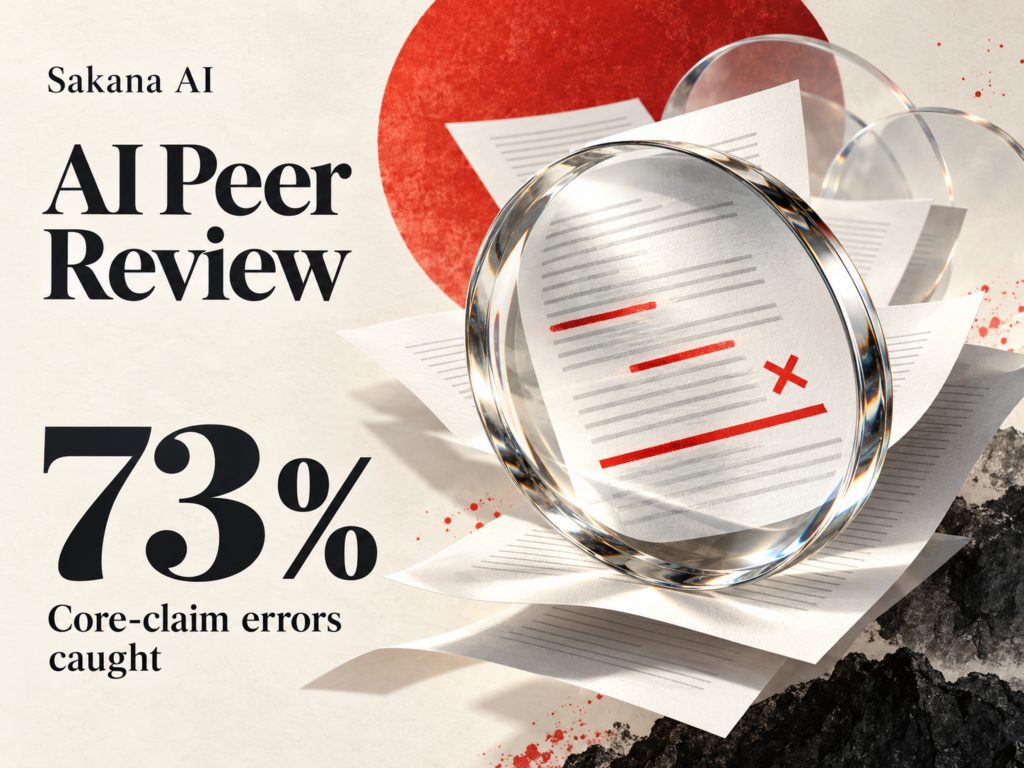
Sakana AI has published research introducing Multi-Layered Review (MLR), an agentic AI peer-review system engineered to identify contradictions and errors in scientific research papers. Built using three specialized agents powered by Claude models, the framework processes complete PDF documents directly to critique paper outlines, verify assumptions, and evaluate experimental consistency.
To measure performance, researchers constructed a Contradiction Benchmark using 257 academic papers with systematically injected errors. In evaluations, MLR successfully identified 73.43% of core-claim contradictions, outperforming existing baselines like AgentReview, which caught 14.81%. The multi-agent design added roughly 25 percentage points in detection accuracy compared to single-prompt baselines.
Operating at an estimated cost of $0.47 per review, MLR demonstrated a 0.586 correlation with human reviewer scoring on ICLR 2025 submissions. While human reviewers weigh clarity and novelty heavily, Sakana AI’s system focuses primarily on experimental validity, providing an automated complementary tool for academic quality control.
Why it matters
Multi-agent LLM architectures significantly outperform single-prompt setups when auditing complex, document-heavy technical workflows.
Automated peer review systems provide a cost-effective verification layer to catch methodological errors before publication.
Source: marktechpost.com