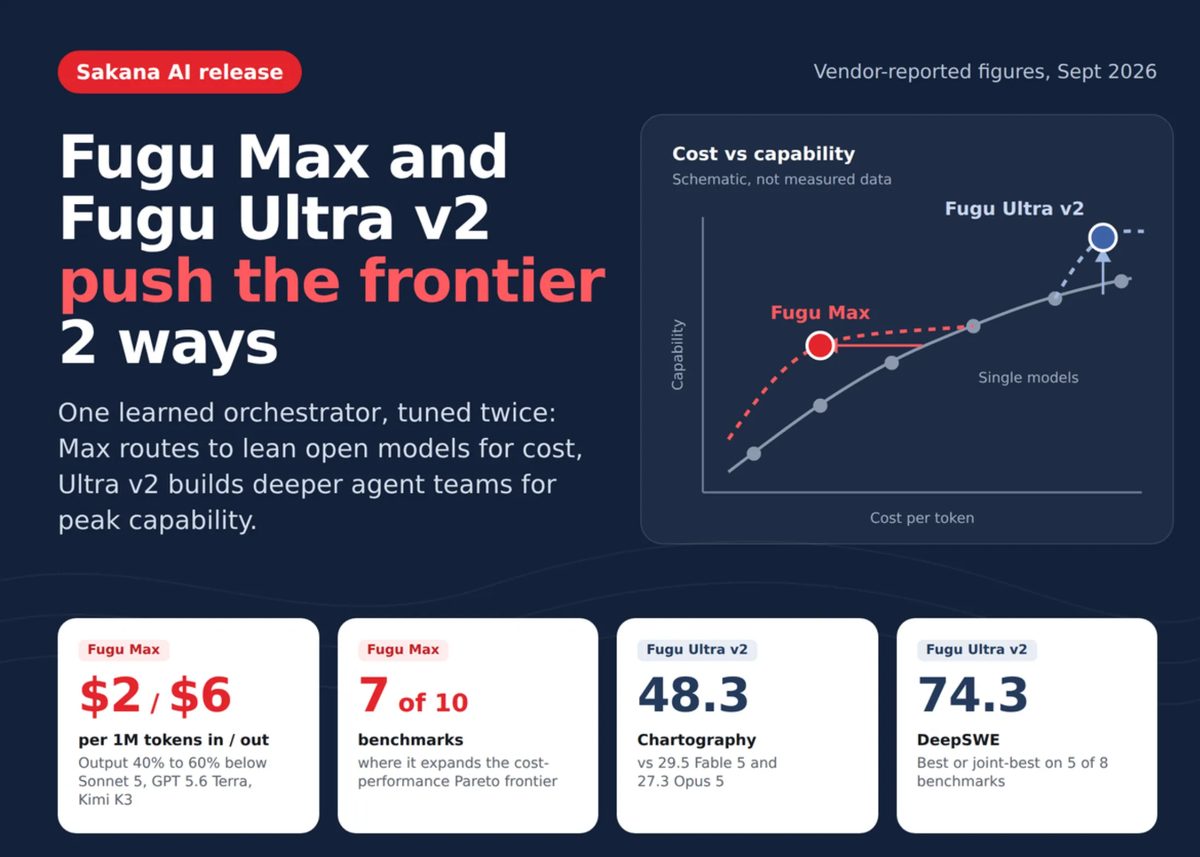
Sakana AI has announced the launch of Fugu Max and Fugu Ultra v2, the latest additions to its Fugu model orchestration system. Rather than operating as a standalone foundation model, Fugu acts as a learned orchestrator that dynamically builds agentic scaffolding and routes tasks across a pool of third-party open-weight and specialized models, including NVIDIA’s Nemotron family. The models are accessible immediately via Sakana’s OpenAI-compatible API, though self-hosted open weights and EU/EEA availability are not offered.
The two variants target different operational priorities along the Pareto frontier of cost and performance. Fugu Max focuses on cost efficiency, routing simpler sub-tasks to smaller models to achieve near-frontier outputs at 2x to 6x lower cost. Fugu Ultra v2 is optimized for complex multi-step reasoning, full-stack software development, and structured data analysis, relying on specialized coordinator roles like Thinker, Worker, and Verifier trained via reinforcement learning and evolutionary algorithms.
Sakana positions the Fugu architecture as a defense against vendor lock-in, API revocations, and reliance on single proprietary foundation models. By dynamically allocating tasks across diverse model backends behind a unified API, the company aims to offer enterprise workloads high capability without the expense of querying massive parameter models for routine tasks.
Why it matters
Offers enterprise operators a practical strategy to reduce inference costs by 2x to 6x using dynamic model routing.
Reduces platform risk and vendor lock-in by decoupling multi-agent agentic workflows from a single proprietary model provider.
Validates reinforcement learning and evolutionary algorithms for automated agent coordination and role assignment.
Source: marktechpost.com