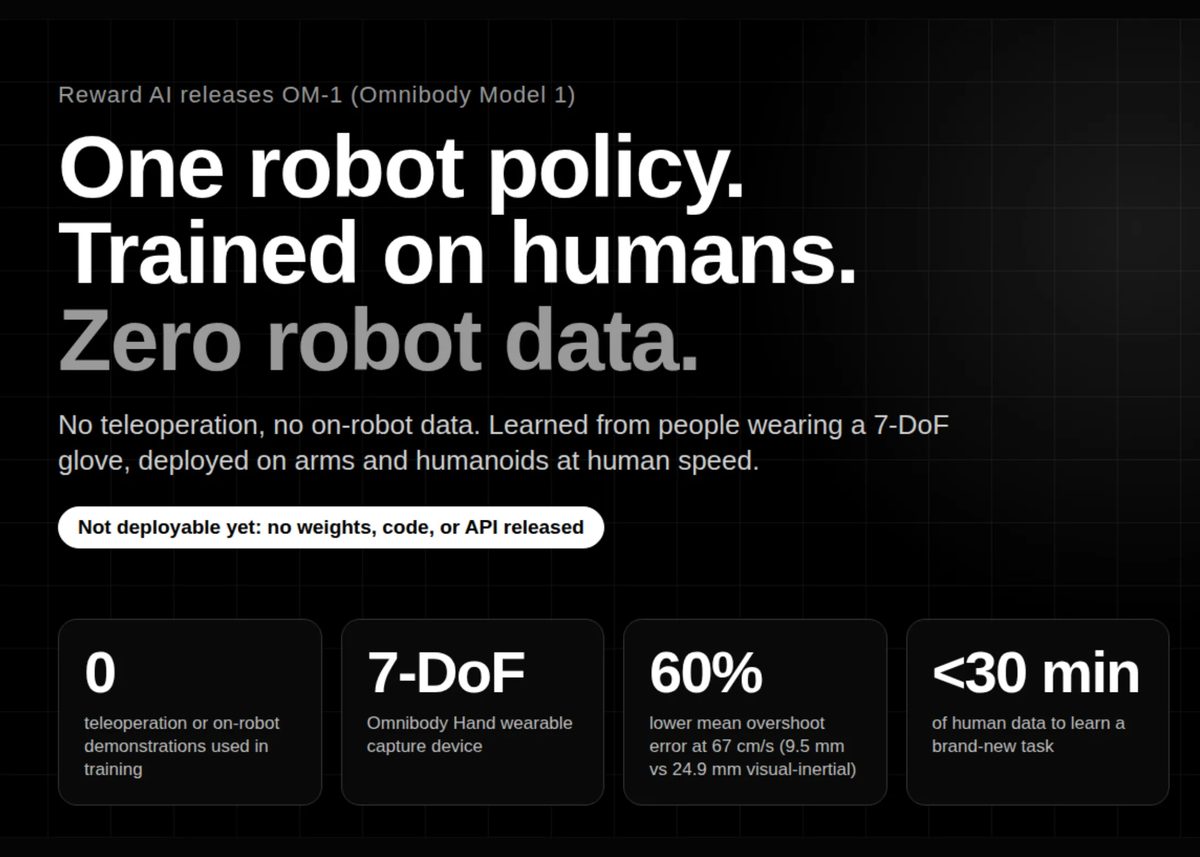
Robotics startup Reward AI has introduced OM-1 (Omnibody Model 1), a general-purpose manipulation policy designed to run on industrial arms and humanoid robots at human speeds. Unlike conventional robotic models that rely on teleoperation or on-robot data collection, OM-1 trains exclusively on human demonstration data captured via wearable hardware. The system utilizes a single policy architecture that handles multimodal data inputs directly without requiring separate pre-training and post-training stages.
Data capture is facilitated by the Omnibody Hand, a custom 7-degree-of-freedom sensorized glove built on the team’s prior DexCap research. The glove incorporates high-frequency tactile sensors, inter-finger proximity sensors, global-shutter cameras, and electromagnetic tracking with disturbance compensation. In benchmark testing, the hybrid electromagnetic tracking system reduced high-speed motion overshoot error by 60% compared to traditional visual-inertial tracking setups.
OM-1 remains an internal policy, with Reward AI releasing no open-source weights, code, datasets, or APIs for external hardware deployment. The company aims to target high-speed industrial applications such as conveyor-belt sorting, asserting that decoupling data collection from specific robot embodiments will enable training data to transfer seamlessly to future robotic hardware designs.
Why it matters
Robotics founders can eliminate expensive teleoperation hardware by shifting toward direct human-demonstration capture systems.
Hardware operators gain potential efficiency improvements from single-stage policies that execute complex manipulation at human speeds.
Investors should monitor embodied AI startups separating data collection hardware from target robotic deployment bodies.
Source: marktechpost.com