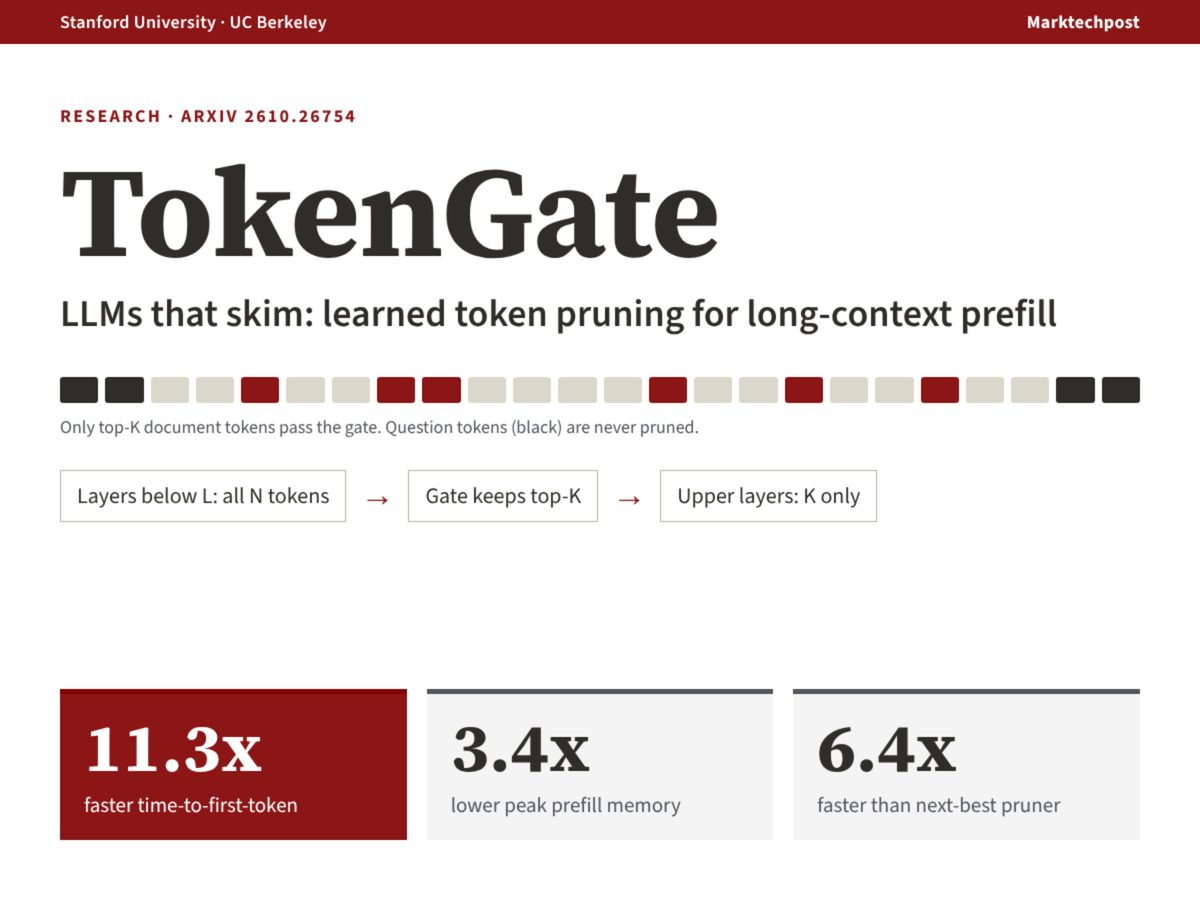
Researchers from Stanford University and UC Berkeley have introduced TokenGate, an open-source module designed to accelerate long-context prefill in large language models. Released under an Apache-2.0 license, the drop-in component trains a soft gating mechanism to prune uninformative document tokens before full attention processing, reducing time-to-first-token (TTFT) by 1.4x to 11.3x without reducing accuracy.
TokenGate addresses the quadratic scaling cost of transformer attention by employing a differentiable router trick inspired by Mixture-of-Experts. By routing gradients through attention logit biases, the gate learns which tokens to drop during standard next-token training. In tests using Qwen models across context benchmarks like RepoBench-P and needle-in-a-haystack, TokenGate decreased peak prefill memory usage by 1.5x to 3.4x compared to dense baseline processing.
The release includes open checkpoints and code requiring PyTorch and CUDA. By enabling dynamic token pruning without requiring full model retraining from scratch, the module offers operational efficiency gains for serving long-context inference workloads.
Why it matters
Drastically cuts inference costs and latency for long-context applications like document processing and codebase analysis.
Provides a drop-in, Apache-2.0 open-source module that integrates with existing LLM pipelines without full pre-training.
Reduces peak memory requirements during prefill, enabling higher throughput on standard GPU infrastructure.
Source: marktechpost.com