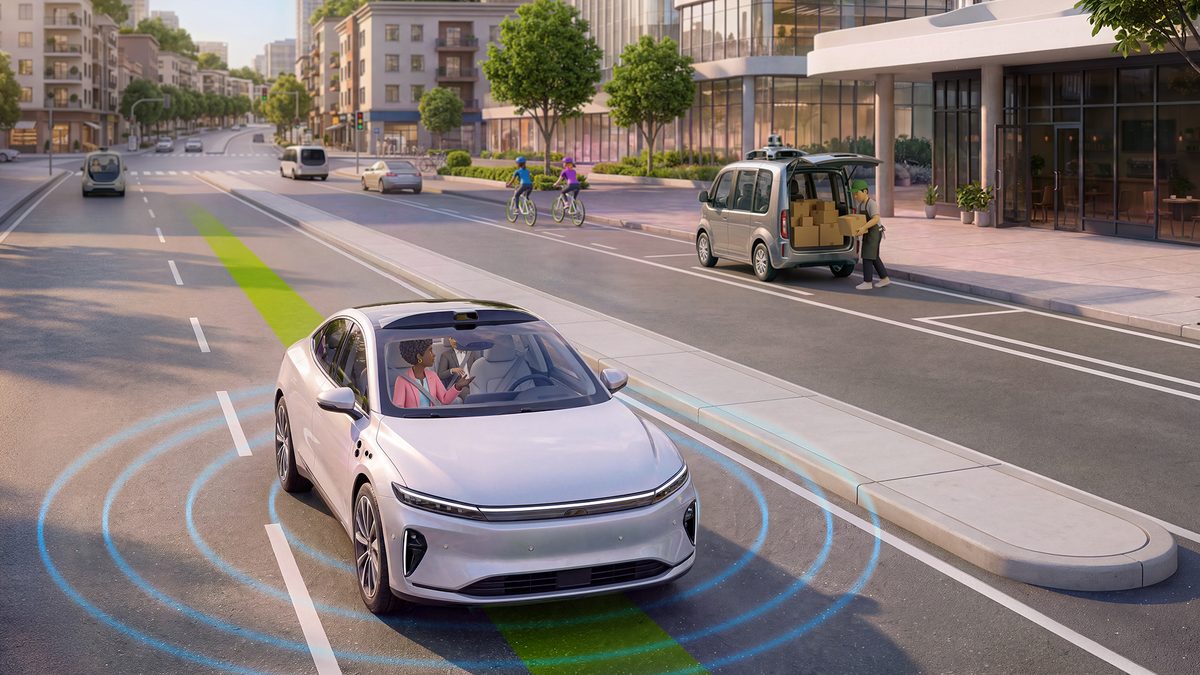
NVIDIA outlined its end-to-end hardware and software architecture powering commercial robotaxi fleets, targeting a market projected to reach $400 billion by 2035 with over 6 million autonomous vehicles. The company’s platform provides a three-computer framework covering model training on DGX systems, simulation and validation via Omniverse and Cosmos foundation models, and real-time in-vehicle processing powered by DRIVE Hyperion compute architecture.
To address complex long-tail driving scenarios, NVIDIA provides the Alpamayo portfolio of vision-language-action (VLA) models, which break difficult driving situations into reasoning steps. For validation, Omniverse NuRec models reconstruct real-world sensor data into digital environments, while Cosmos world models generate synthetic environmental variations. The in-vehicle DRIVE Hyperion 10 setup pairs dual DRIVE AGX Thor chips on the Blackwell architecture with 38 sensors to deliver real-time, redundant sensor fusion.
Why it matters
Autonomous vehicle developers can utilize open VLA reasoning models and synthetic world generation to safely navigate edge cases without physical testing miles.
Scaling driverless operations requires integrated compute infrastructure spanning high-performance cloud training, closed-loop simulation, and high-redundancy onboard edge chips.
Source: blogs.nvidia.com