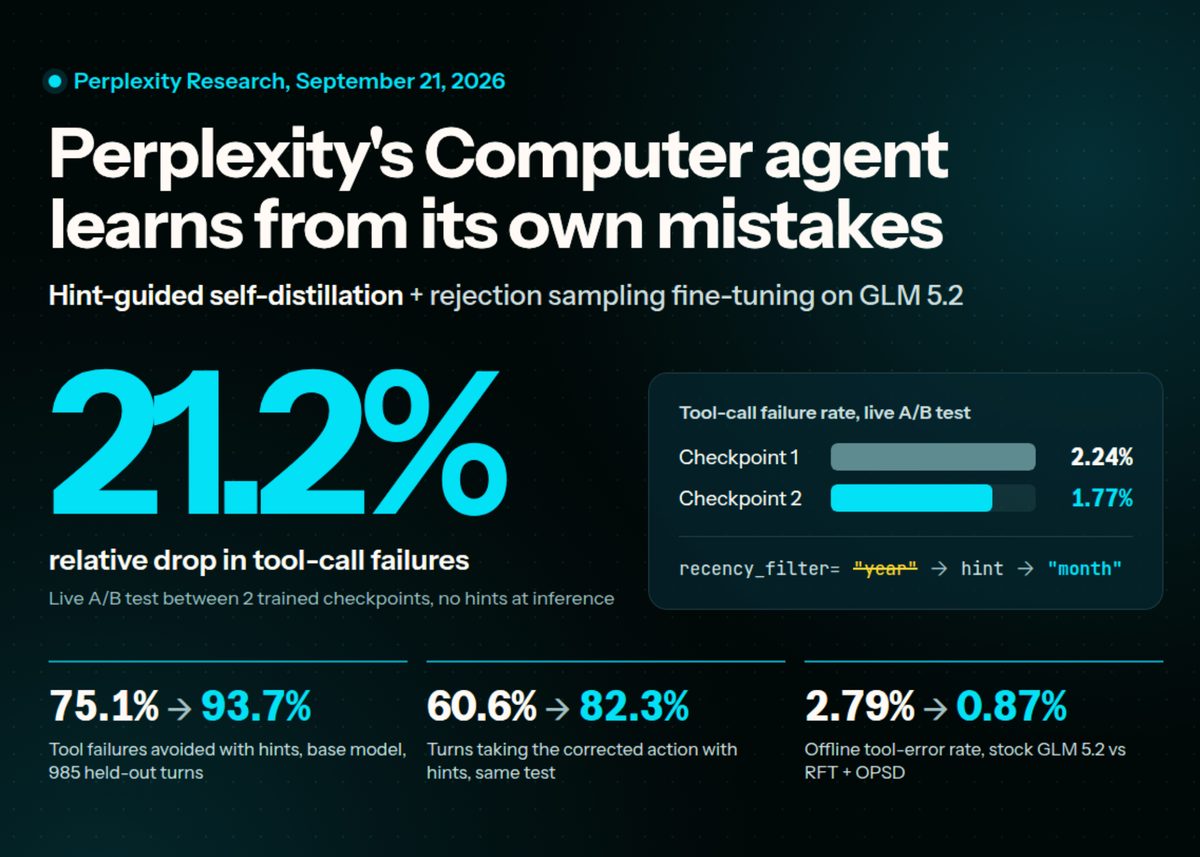
Perplexity Research has detailed a new post-training methodology designed to improve tool-calling reliability in AI agents using real-world session data. The approach combines rejection sampling fine-tuning with hint-guided self-distillation, specifically targeting mistakes made during failed user interaction sessions.
In live A/B testing on Perplexity Computer, the training technique reduced tool-call failure rates from 2.24% to 1.77%, representing a statistically significant 21.2% relative reduction. Rather than discarding failed sessions—which can erase evidence of recoverable errors—the pipeline generates short corrective hints for incorrect steps and uses On-Policy Self-Distillation to align the model’s predictions.
The post-training pipeline was evaluated on top of the open-weights GLM 5.2 base model. While the underlying base model is available on Hugging Face, Perplexity has not open-sourced the fine-tuned weights or training scripts.
Why it matters
AI agent developers can adopt hint-guided self-distillation techniques to systematically reduce runtime tool-call errors in production.
Engineering teams can salvage valuable training signal from failed user sessions rather than relying exclusively on successful trajectories.
Source: marktechpost.com