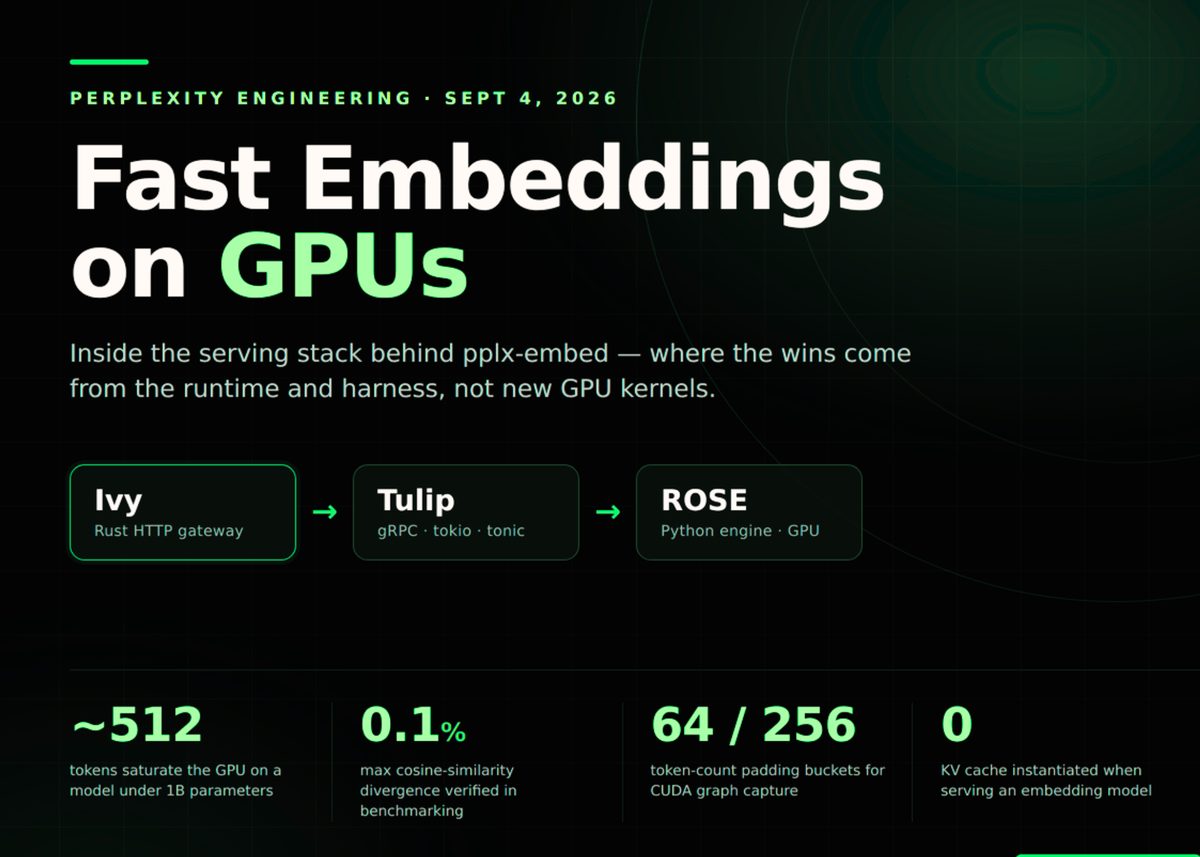
Perplexity’s engineering team has revealed details of its embedding inference infrastructure, which powers pplx-embed and search ranking models across its product suite. Rather than deploying a dedicated embedding engine, Perplexity reuses the prefill and decode kernels from its main LLM stack. The runtime relies on custom components named Ivy, Tulip, and ROSE to manage CUDA graphs, asynchronous host-device transfers, and ragged attention backends on modern GPU hardware.
To overcome CPU launch overheads on small models, the system constructs full-model CUDA graphs using a lazy capture strategy that defers optimization until a configuration’s second execution hit. A Rust-based async request path uses a custom LazyTensor abstraction to overlap CPU batch preparation with GPU execution. For attention, the ROSE backend dynamically routes workloads across FlashInfer 2, FlashInfer 3, and FlashAttention 4 based on model architecture and sequence length without instantiating KV caches.
The release provides a technical blueprint for serving high-throughput, low-latency vector embeddings at scale. By adapting standard LLM serving optimizations to small transformer architectures, Perplexity demonstrates significant latency and cost improvements over default configurations in framework engines like vLLM.
Why it matters
Provides an optimized blueprint for unified embedding and ranking inference without maintaining standalone vector inference engines.
Demonstrates lazy CUDA graph capture and asynchronous memory tracking techniques to minimize CPU launch overheads in real-time search.
Shows how dynamic attention backend selection (FlashInfer vs. FlashAttention) reduces compute costs across varying sequence lengths.
Source: marktechpost.com