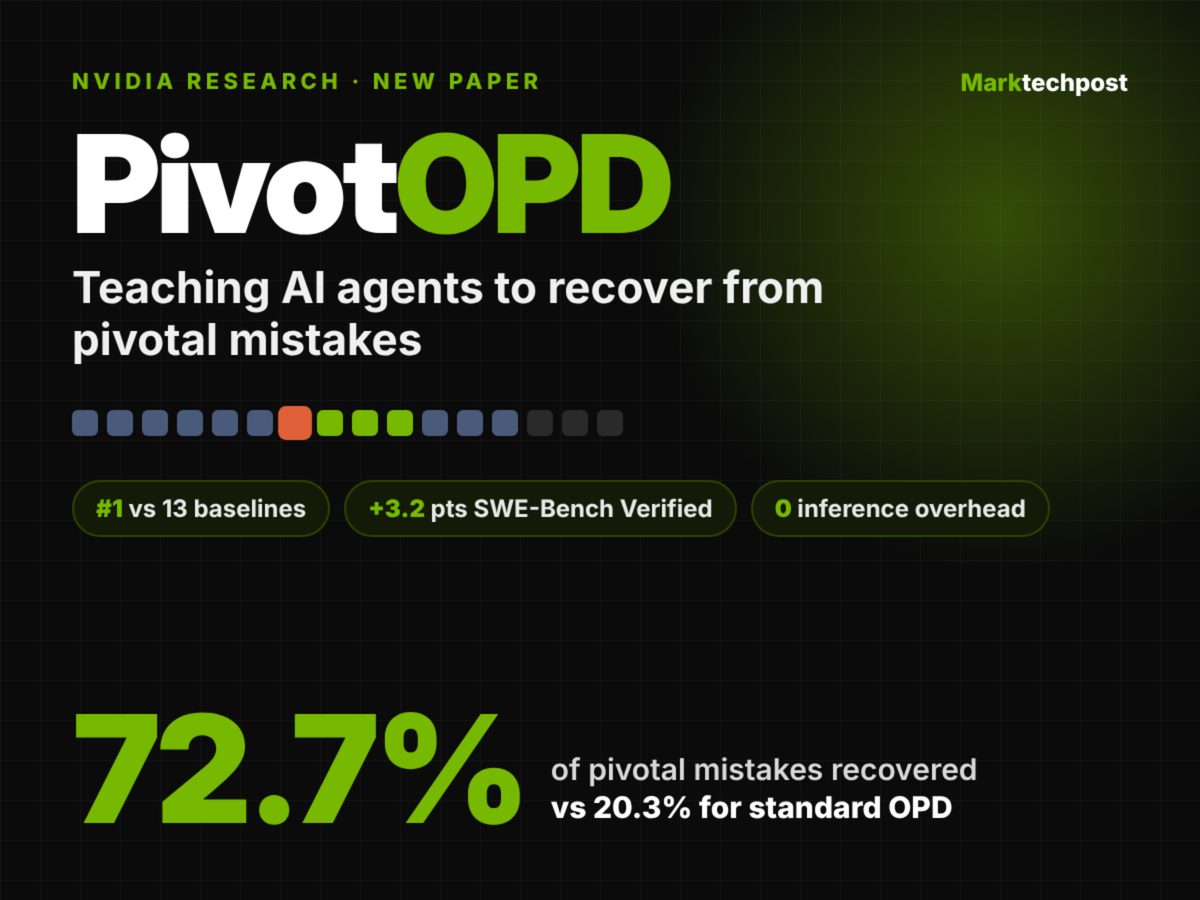
Researchers from Nvidia, Princeton University, and the University of Maryland have published PivotOPD, a novel on-policy distillation method designed to teach LLM agents how to recover from critical errors. The study found that 59% of agent failures stem from a “pivotal mistake” made early in the workflow (median turns 8 to 12), after which agents waste 18 to 21 turns without recovering. Standard distillation methods rarely correct these errors because the probability of sampling the correct action after a mistake remains below 1%.
PivotOPD addresses this blind spot by integrating three components into group-based RL within a single PPO update, using hints from the student model’s own distribution rather than relying solely on teacher trajectory targets. When tested using Qwen3-1.7B and Qwen3-8B student models, PivotOPD outperformed 13 baseline algorithms across the ALFWorld, WebShop, and Search-based QA benchmarks, raising the 8B model’s ALFWorld success score to 93.0%.
Crucially, PivotOPD dramatically improves agent resilience without increasing inference costs. Across 72 replayed pivotal errors, agents trained with PivotOPD successfully recovered 72.7% of the time, compared to just 8.3% for the base model and 20.3% for standard OPD. On SWE-Bench Verified, a Nemotron student model trained with PivotOPD saw performance increase from 62.8% to 66.0%.
Why it matters
Early-turn error propagation is the leading cause of multi-turn agent failure; fixing recovery mechanics drastically boosts task success rates.
PivotOPD improves agent performance at zero additional inference cost, requiring extra compute only during the training phase.
Smaller student models (1.7B and 8B) achieve frontier-level agent execution when trained on-policy to recover from pivotal mistakes.
Source: marktechpost.com