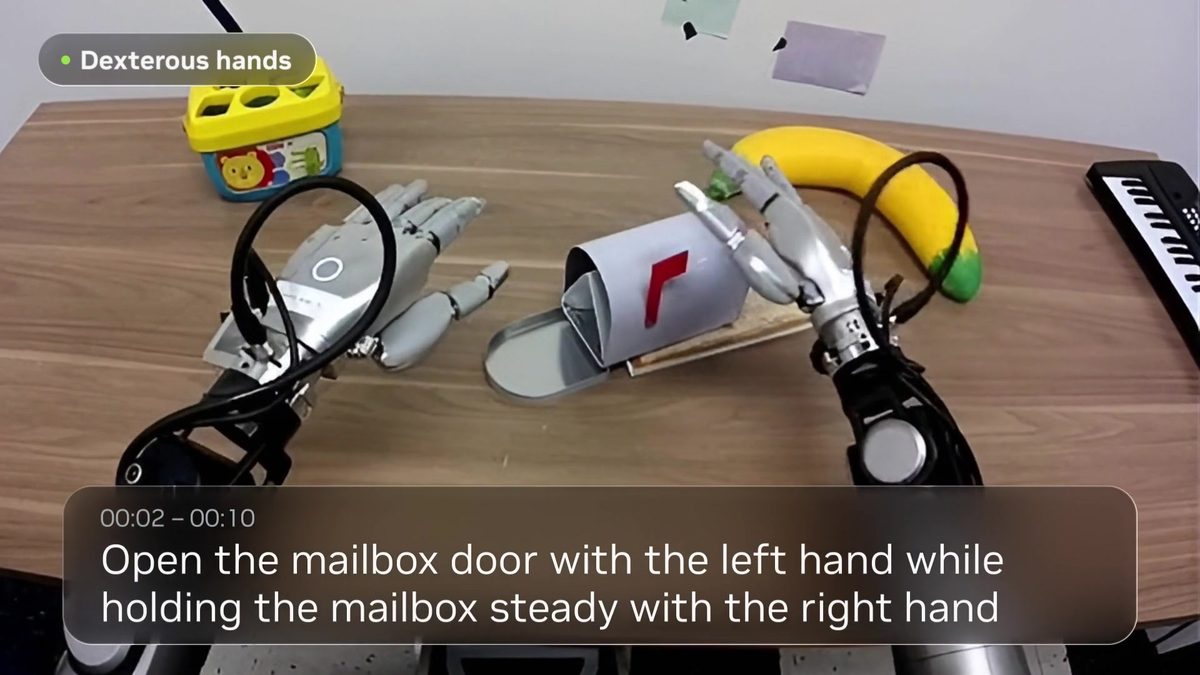
Nvidia’s GEAR research lab has released Flora, an open-source data engine designed to generate three critical types of video labels for training robotics models. Flora utilizes three fine-tuned Qwen3.5 models to segment actions, describe context, and rate robot task execution step-by-step. The system is currently deployed across 512 GB300 GPUs to annotate up to 200,000 hours of training video daily for Nvidia’s GR00T models.
According to Nvidia, Flora lowers video labeling costs to roughly $0.72 per hour, compared to projected costs of $88.50 per hour using OpenAI’s GPT-6 Astra. Benchmarks show Flora outperforms commercial LLMs on specific localization and step-error identification tasks, though Astra retains advantages in rubric scoring and overall descriptive accuracy.
The models and codebase have been made available on Hugging Face. Nvidia aims to reduce data pipeline bottlenecks for robotics developers scaling multimodal learning models.
Why it matters
Significantly lowers data annotation expenses, making large-scale robotic model training viable for resource-constrained startups.
Demonstrates specialized fine-tuned open models outperforming massive frontier models on niche multimodal tracking tasks.
Provides an immediate tooling upgrade for teams building autonomous embodied AI and physical robotics workflows.
Source: the-decoder.com