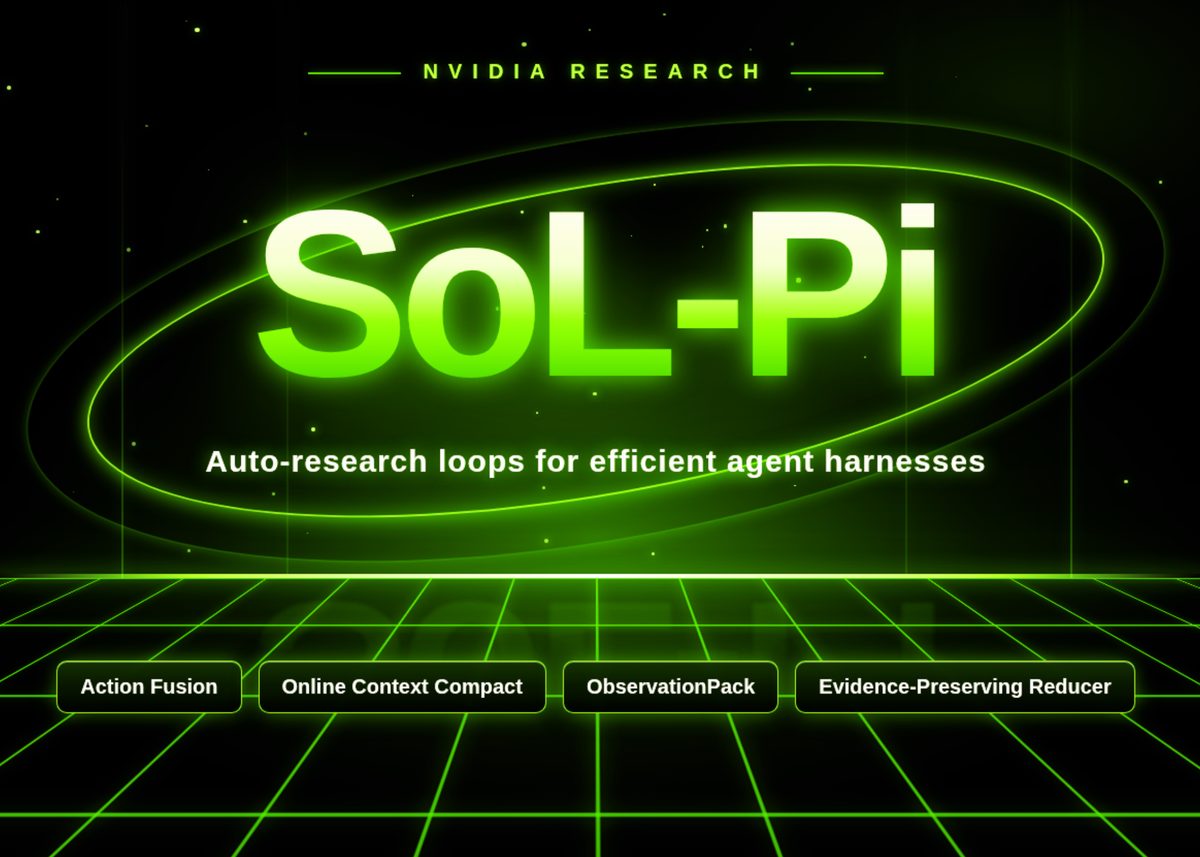
Researchers from NVIDIA, NTU, and MIT have released SoL-Pi, a suite of four efficiency mechanisms for the open-source Pi coding agent that reduces token traffic by up to 49% and API costs by approximately 33%. Tested on the 51-task EdgeBench evaluation, the extension optimizes the harness layer—the system managing tool calls, context, and execution—by using automated research loops to discover efficiency improvements.
The system runs as an MIT-licensed extension available on GitHub under NVlabs, compatible with Pi 0.85.1 and Node.js 22.19+. When tested across models like GPT-5.6 Sol and Opus 5, SoL-Pi maintained over 93% of the base agent’s score while significantly lowering context overhead. Individual mechanisms within the harness, such as ObservationPack and Action Fusion, even boosted raw task scores on specific backends.
Instead of focusing on traditional model compression like quantization or faster kernels, SoL-Pi demonstrates that optimizing the agent harness layer offers massive cost reductions. This approach lowers the barriers to running long-horizon, autonomous software engineering agents in production environments.
Why it matters
Lower inference costs: Reducing token consumption by up to 49% significantly cuts API bills for long-running software engineering agents.
Harness optimization: Teams can achieve higher efficiency by algorithmic tuning of agent context and execution loops rather than changing underlying LLMs.
Production readiness: Open-source MIT licensing allows immediate integration into existing agentic developer workflows.
Source: marktechpost.com