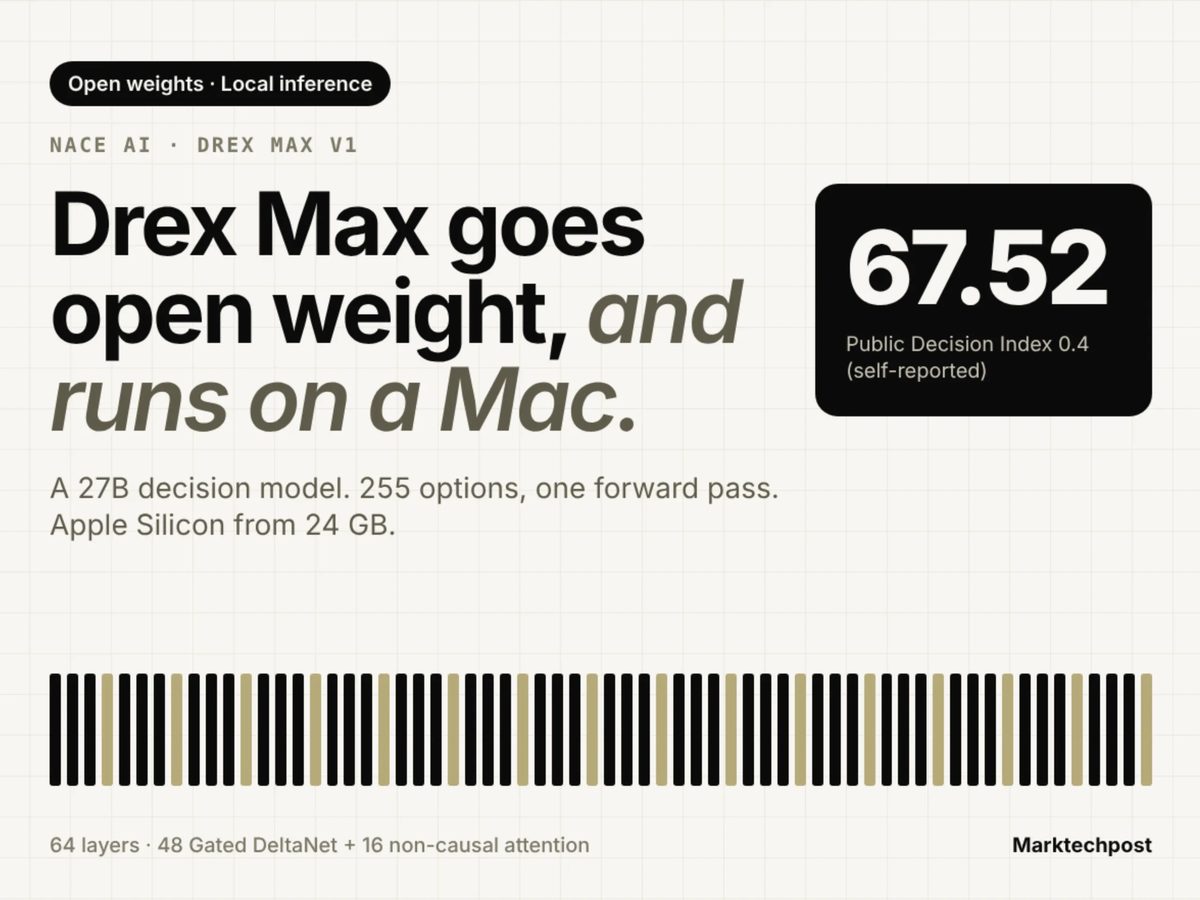
Nace AI has released the open-weight code and parameters for Drex Max v1, a dense 27-billion parameter decision model capable of running locally on Apple Silicon. Optimized for developer workflows using llama.cpp and Ollama, the release includes bf16 weights alongside Q8_0 GGUF and affine Q4 quantized checkpoints targetting Macs with 24 GB to 48 GB of RAM.
Unlike traditional generative models, Drex Max evaluates a provided context—such as text, JSON, or images—and outputs direct option probabilities in a single forward pass without generating text. Its architecture pairs 48 Gated DeltaNet linear-attention layers with 16 non-causal full-attention layers and a native vision tower, making it specialized for operational tasks like agent routing, policy enforcement, and ticket triage.
According to Nace AI, tests on an Apple M5 Pro showed that the local Q8_0 GGUF benchmarked within 0.02 per probability of an H100 GPU running full bf16 precision without choice flips. By processing routing and guardrail checks locally, developers can maintain privacy and eliminate cloud API latencies for embedded AI workflows.
Why it matters
Enables zero-latency, private execution of agent routing and guardrails locally on standard Apple Silicon hardware.
Replaces costly generative API calls with a deterministic 27B decision model that outputs choice probabilities in a single pass.
Demonstrates non-causal, hybrid linear-attention architectures operating effectively on edge devices without accuracy loss.
Source: marktechpost.com