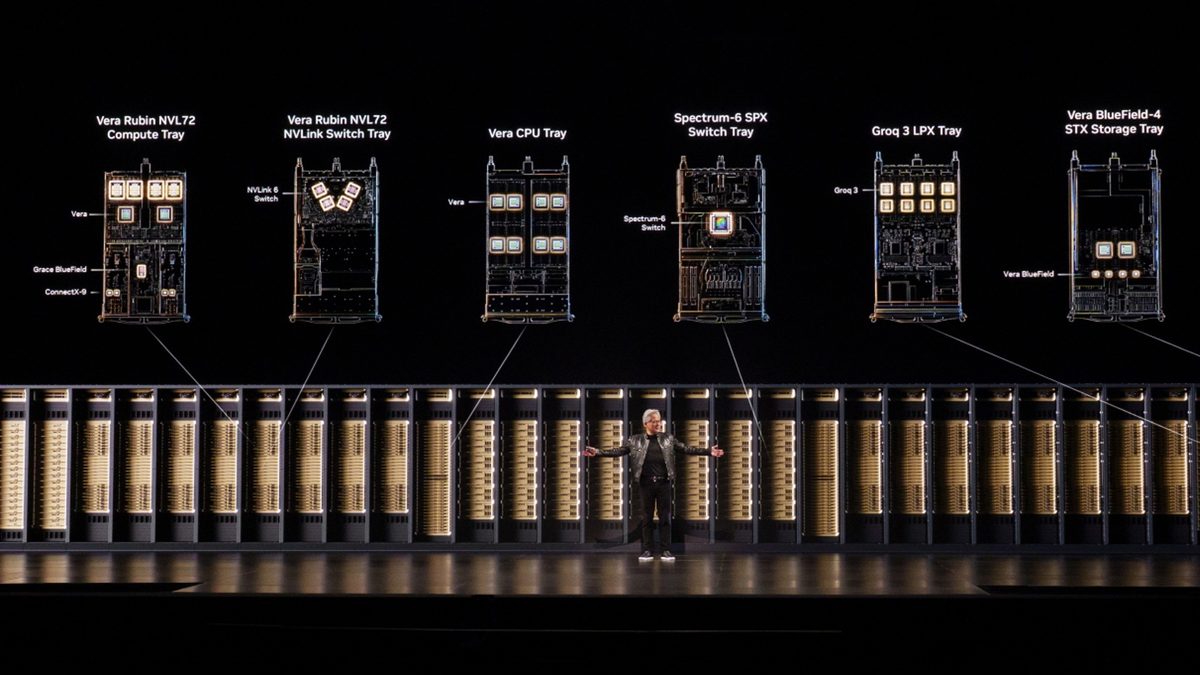
NVIDIA detailed its full-stack codesign architecture aimed at addressing escalating GPU memory pressure caused by larger models, expanded KV caches, and multi-million-token agentic workflows. As memory supply tightens and costs rise, the chipmaker is integrating GPUs, CPUs, networking, storage, and software layers to optimize data throughput across the entire AI compute hierarchy.
According to NVIDIA, simply adding High Bandwidth Memory (HBM) capacity per GPU reaches physical efficiency limits known as the memory wall, where data bandwidth cannot keep pace with compute availability. To overcome these limits, NVIDIA’s platform offloads inactive context and weights across lower-tier CPU memory, local SSDs, and shared storage systems while maintaining high utilization on expensive HBM tiers.
Company metrics demonstrate that transitioning from the NVIDIA Blackwell Ultra to the Vera Rubin platform yielded up to a 30x increase in agentic throughput per dollar on the SemiAnalysis AgentX benchmark, despite HBM capacity per GPU increasing by only roughly 3 percent.
Why it matters
Memory bandwidth and capacity are replacing raw compute as the primary scaling bottleneck and cost driver for multi-agent LLM workloads.
Full-stack hardware-software integration yields up to 30x throughput-per-dollar gains without requiring massive hardware memory expansion.
Infrastructure teams must optimize KV cache offloading and tiered storage strategies to control operational costs on long-context inference.
Source: blogs.nvidia.com