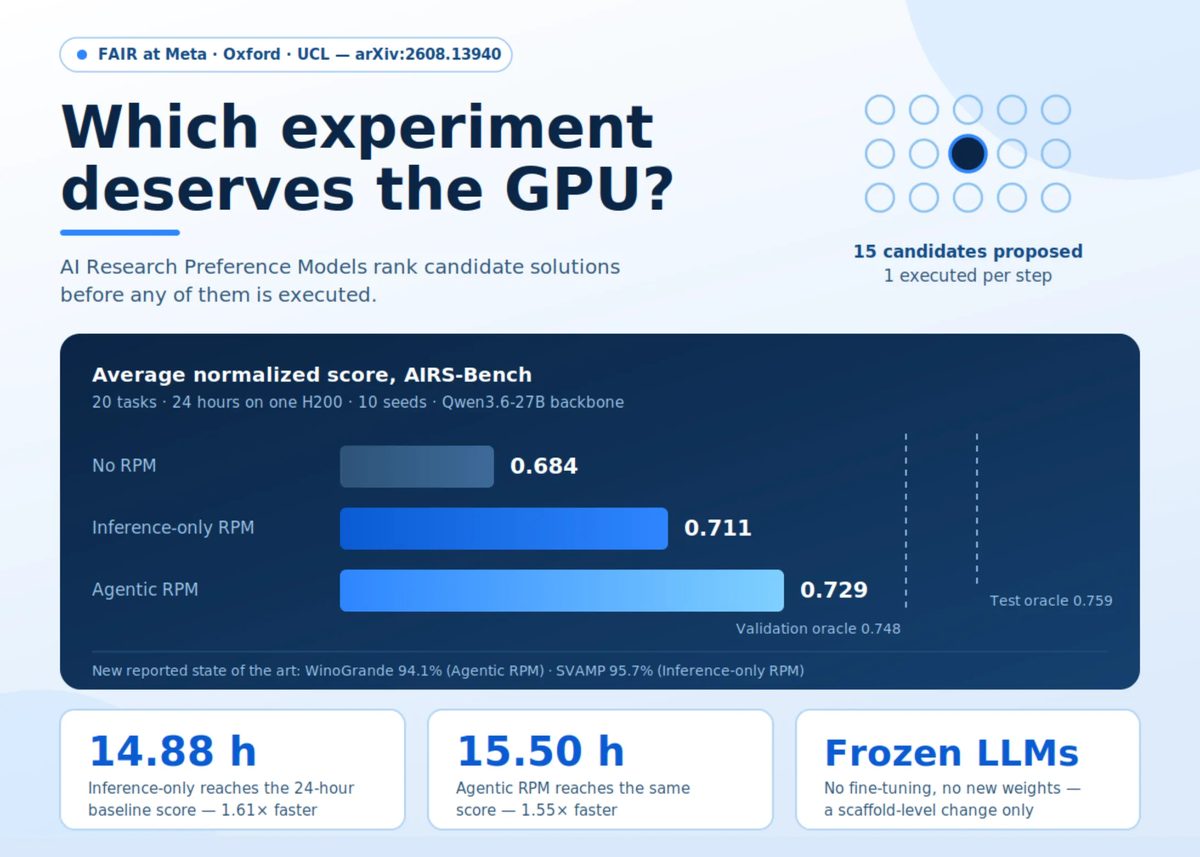
Researchers from Meta FAIR, the University of Oxford, and University College London have introduced AI Research Preference Models (RPMs), a methodology designed to rank proposed machine learning experiments before allocating GPU runtime. By evaluation-ranking candidate code changes prior to execution, RPMs address the bottleneck where AI research agents generate more potential hypotheses than compute budgets can afford to run.
RPMs utilize frozen open-weights LLMs without fine-tuning to select top candidates from parallelized experiment prompts. Tested using the Qwen3.6-27B backbone on the open-source AIRA-dojo framework across 20 public tasks, the system demonstrated a roughly 1.55x to 1.61x speedup in reaching baseline accuracy levels compared to unguided agent search, adding minimal inference overhead per run.
The research yields state-of-the-art results on standard benchmarks like WinoGrande and SVAMP when paired with automated search loops. The supporting frameworks, evaluation suites, and methodology have been made open source for the machine learning research community.
Why it matters
Pre-evaluating ML experiment code reduces GPU wastage, making automated AI research agents far more capital-efficient.
Open-source scaffolding enables engineering teams to optimize localized LLM training and hyperparameter search pipelines.
Source: marktechpost.com