Meta Superintelligence Labs has released Muse Spark 1.3, marking its fourth Muse Spark update in five months. The new model focuses on long-horizon agentic workflows and multi-turn collaborative coding rather than single-turn generation. Muse Spark 1.3 is available immediately via Muse Code and the Meta Model API for production use, though weights remain closed and its maximum reasoning mode is gated behind safety testing.
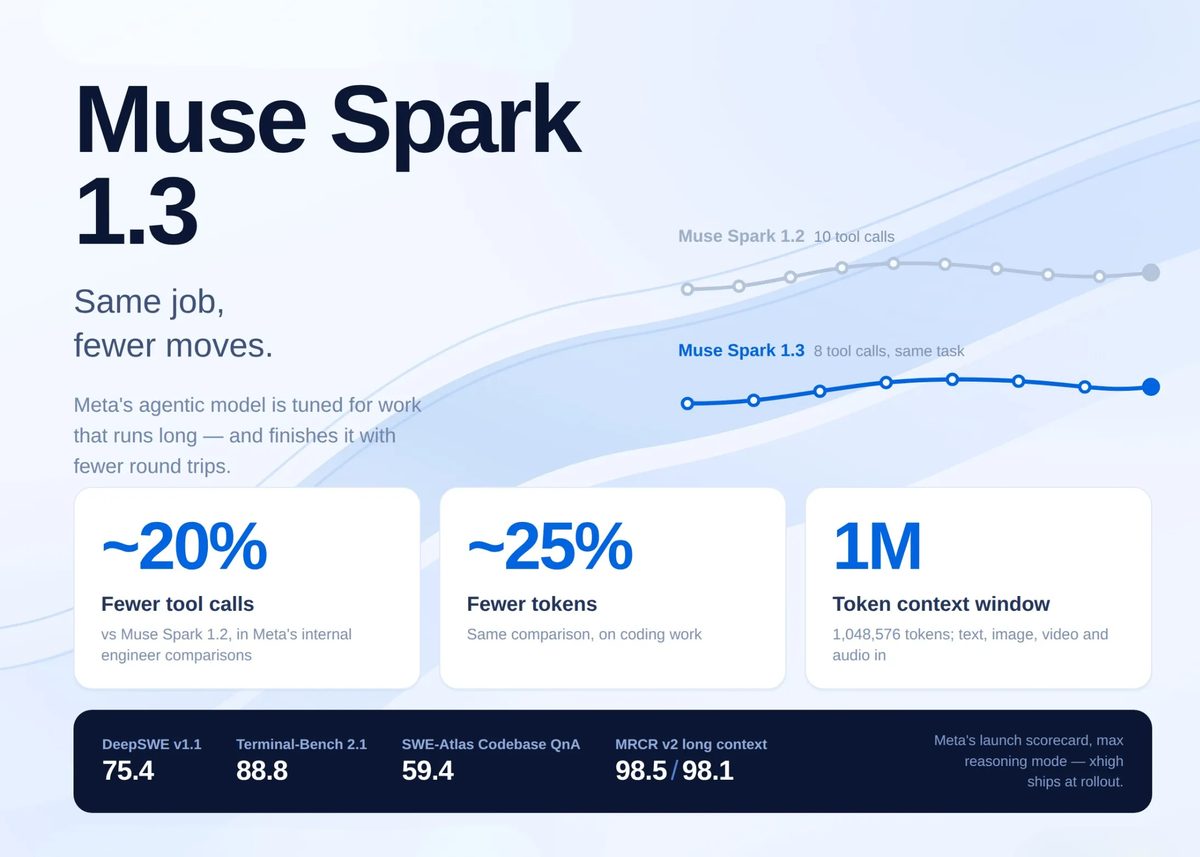
Designed to handle open-ended objectives, Muse Spark 1.3 gathers context from conflicting sources, adapts to user execution preferences, and asks clarifying questions when stalled. On long-horizon coding tasks, internal Meta engineering tests show the model uses roughly 20% fewer tool calls and 25% fewer tokens compared to version 1.2, directly reducing inference costs for agentic workloads. On benchmark evaluations, Muse Spark 1.3 scored 75.4 on DeepSWE v1.1—ahead of Claude Opus 5 (74.0) and GPT-5.6 Sol (72.7)—and achieved 98.5 on 256K–512K context retrieval.
Third-party evaluations by Artificial Analysis rank the model’s shipping “xhigh” reasoning tier level with GPT-5.6 Sol and Grok 4.6 on its Intelligence Index. By optimizing for fewer turns and lower token consumption, Meta is positioning the model to lower operational expenses for enterprise developers deploying continuous software agents.
Why it matters
AI operators can achieve lower operational costs for agentic coding due to a 25% reduction in billed tokens per task.
Developers gain stronger context retrieval across long threads (up to 1M tokens) without needing self-hosted open weights.
Founders building agent frameworks can leverage improved tool-calling efficiency to reduce latency and execution failures in long-horizon workflows.
Source: marktechpost.com