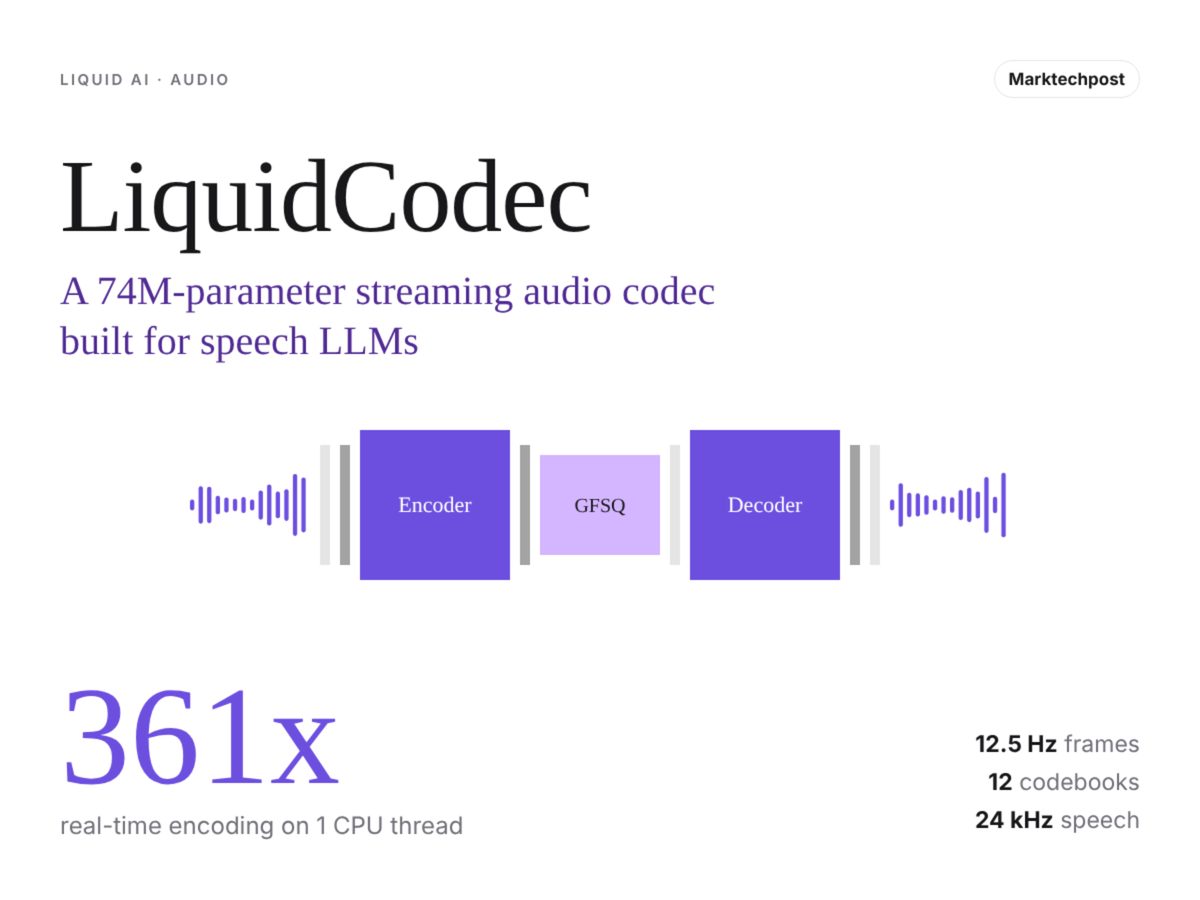
Liquid AI has open-sourced LiquidCodec, a 74-million-parameter streaming audio codec designed to convert speech into discrete tokens for language model processing. Available on Hugging Face, the codec powers Liquid AI’s LFM3 audio and omni models, replacing third-party tokenizers with an architecture focused on low-latency token generation and fast speech reconstruction.
LiquidCodec processes 24 kHz audio into 12 token streams per 80ms frame using grouped finite scalar quantization (GFSQ). By predicting spectral coefficients directly in its decoder, the architecture avoids standard transposed-convolution upsampling costs. The company reported CPU processing speeds up to 361x real-time for encoding and 87x for decoding on an Apple M4 Max chip.
The model release includes quantization-aware training (QAT) builds optimized for edge deployment using llama.cpp and GGUF formats. Liquid AI claims the 4-bit quantized decoder reduces footprint sizes by 3.5x with minimal quality loss on standard speech evaluation benchmarks.
Why it matters
Enables ultra-low latency, edge-compatible voice AI applications by significantly reducing encoding and decoding overhead.
Replaces traditional residual vector quantization with parallelizable GFSQ, simplifying transformer-based audio generation pipelines.
Provides open-source weights and GGUF builds for developers deploying local streaming speech-to-speech models.
Source: marktechpost.com