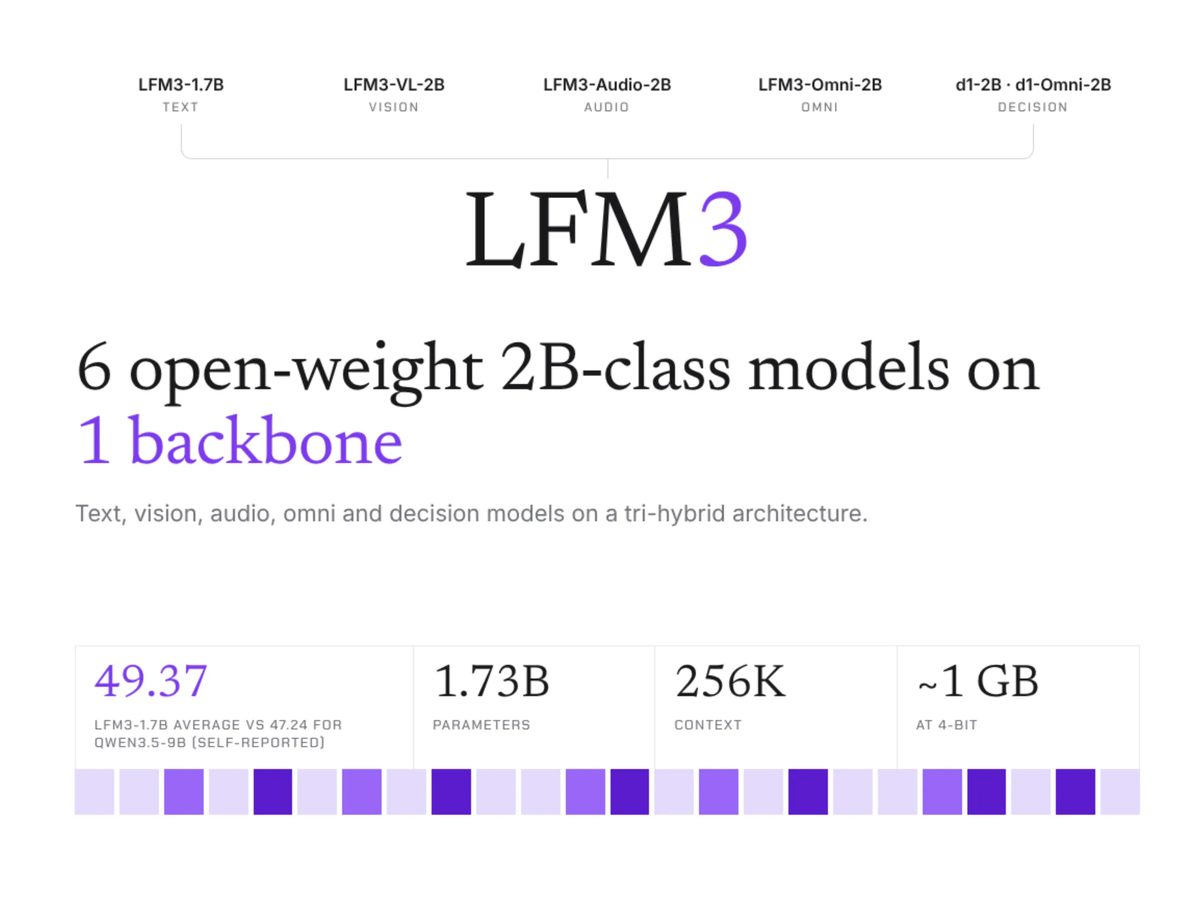
Liquid AI has announced LFM3, a family of six open-weight, 2B-class foundation models built upon a shared base model, LFM3-1.7B-Base. The suite spans specialized variants for text, vision, audio, omni, and decision-making tasks, designed to be fine-tuned on a single GPU and deployed across devices ranging from mobile phones and microcontrollers to private servers and cloud instances.
Architecturally, the LFM3 backbone utilizes a mix of gated short convolutions, sliding-window attention, and global attention across 24 layers, identified via multi-device hardware-in-the-loop architecture search. Pre-trained on 22 trillion tokens with mid-training targeted at extended 256K context and agent workflows, the base model beats predecessor baselines while maintaining low memory footprints.
Liquid AI reported strong benchmark evaluations, noting that LFM3-1.7B outperforms larger models like Qwen3.5-9B on web navigation (WebArena-Verified) and function calling (BFCL V4). Model weights, GGUF, MLX, and ONNX formats, alongside integration tools for popular open-source runtimes, have been made publicly available on Hugging Face and the Liquid API.
Why it matters
Enables high-performance agentic and multimodal workflows on edge devices, significantly reducing memory and compute requirements.
Provides open-weight alternatives that beat larger parameters models on targeted benchmarks like web navigation and tool execution.
Offers enterprise developers adaptable, low-latency base models capable of cheap local fine-tuning for specialized domain applications.
Source: marktechpost.com