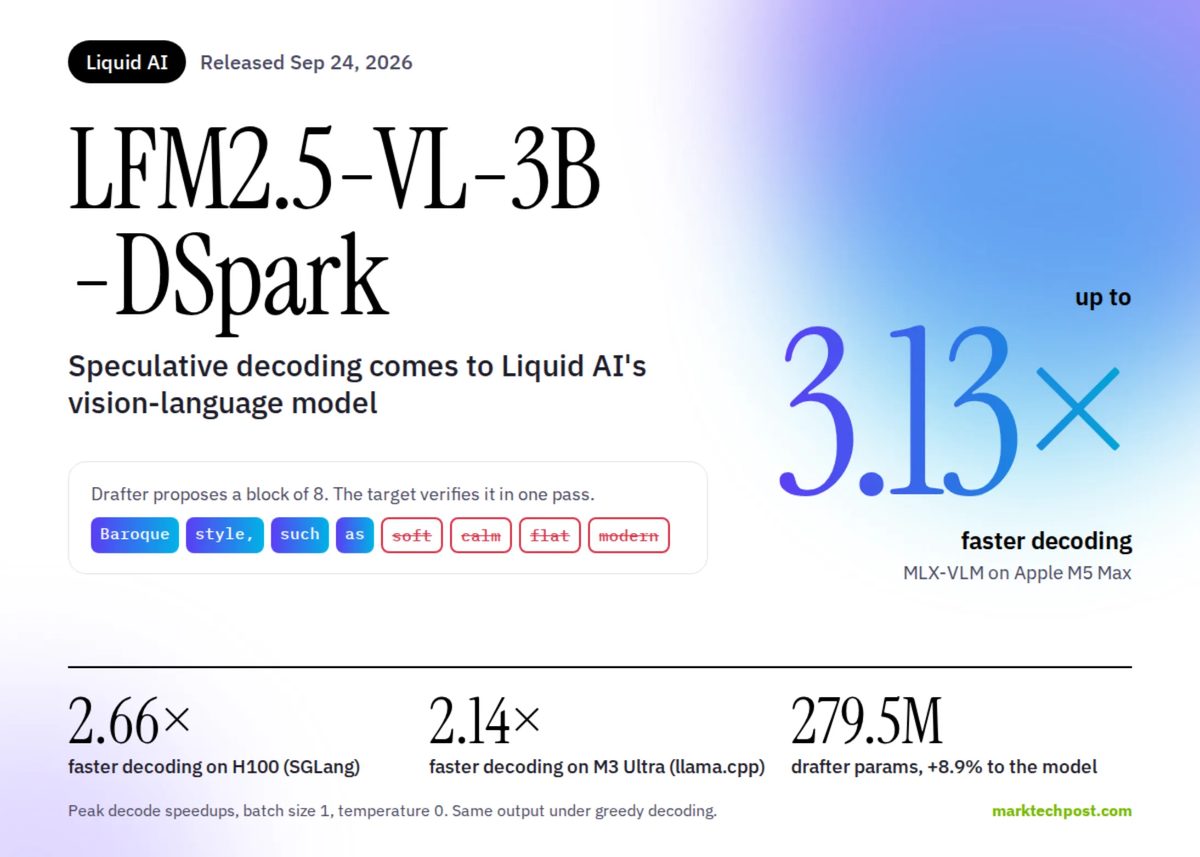
Liquid AI has introduced LFM2.5-VL-3B-DSpark, an experimental speculative-decoding draft model designed to accelerate its LFM2.5-VL-3B vision-language architecture. The release adds roughly 280 million parameters and achieves up to 3.13x faster decoding on Apple silicon and 2.66x on NVIDIA H100 GPUs without altering model output. Weights are published under the LFM Open License v1.0 on Hugging Face, offering commercial use for entities generating under $10 million in annual revenue.
The DSpark drafter operates by predicting candidate tokens directly from the primary model’s internal hidden states, treating visual and text representations identically. By leveraging a simplified attention mechanism with a recommended block size of 8 or 9, the architecture increases total deployed parameter counts by 8.9% while maintaining target output distributions under greedy decoding verification.
Because speculative decoding speeds up token generation rather than visual encoding or prompt prefill, overall end-to-end performance gains remain constrained on compute-limited edge hardware. Liquid AI noted that higher inference sampling temperatures degrade token acceptance rates, slightly reducing the effective throughput boost during creative generation tasks.
Why it matters
Speculative decoding enables significant generation speed improvements for vision-language applications without degrading model accuracy.
Day-one support across MLX-VLM, SGLang, and llama.cpp allows rapid local and server-side evaluation for edge developers.
Commercial usage restrictions for companies above $10M revenue require larger enterprises to seek custom licensing.
Source: marktechpost.com