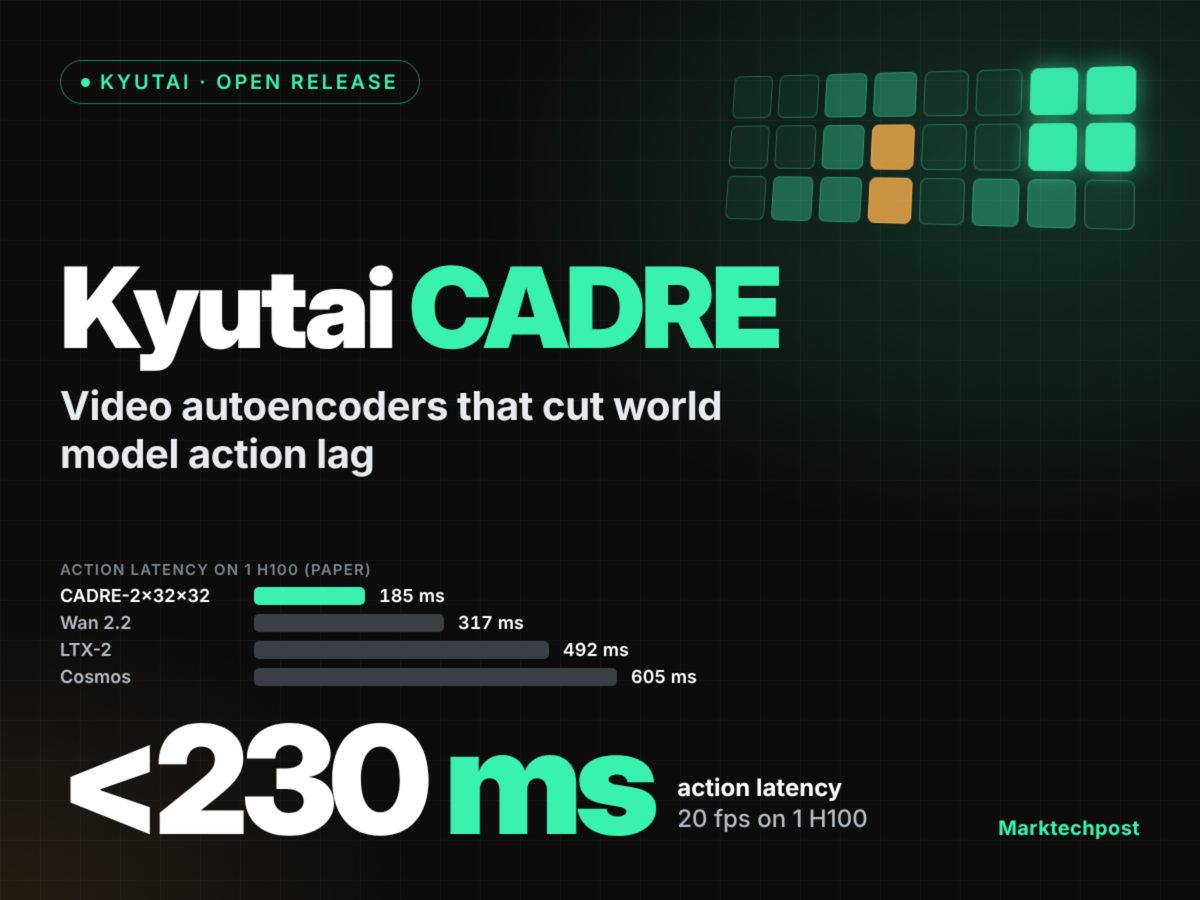
Kyutai has released CADRE, a family of open-source causal diffusion representation autoencoders aimed at eliminating action lag in interactive world models. Trained on 76,000 hours of public video data, CADRE uses a frozen DINOv3 feature extractor and a one-step causal diffusion transformer decoder to achieve low-latency video generation. On an NVIDIA H100 GPU, CADRE models generate video at over 20 frames per second with response times as low as 185 milliseconds.
The architecture addresses a core limitation in traditional text-to-video autoencoders, which pack multiple frames into single latents and introduce noticeable delays during interactive generation. By employing progressive self-distillation, CADRE achieves fast decoding without requiring adversarial loss functions. Kyutai evaluated CADRE across four distinct environments—robot manipulation, human manipulation, driving, and indoor navigation—outperforming alternative models like Wan 2.2, LTX-2, and Cosmos in action response rates and motion quality.
While CADRE demonstrates strong latency improvements, Kyutai acknowledged limitations in specific domains like robot manipulation reconstruction and chunk boundary seams. The code is available under an MIT license, while model weights are distributed under CC BY-NC 4.0 for non-commercial research use.
Why it matters
Lowers generation latency below the human perception threshold of 230 ms, enabling real-time interactive world models and robotics control.
Demonstrates that progressive self-distillation can accelerate diffusion decoding to a single step without sacrificing motion quality.
Non-commercial weights license restricts direct enterprise integration, though the open code allows custom internal training.
Source: marktechpost.com