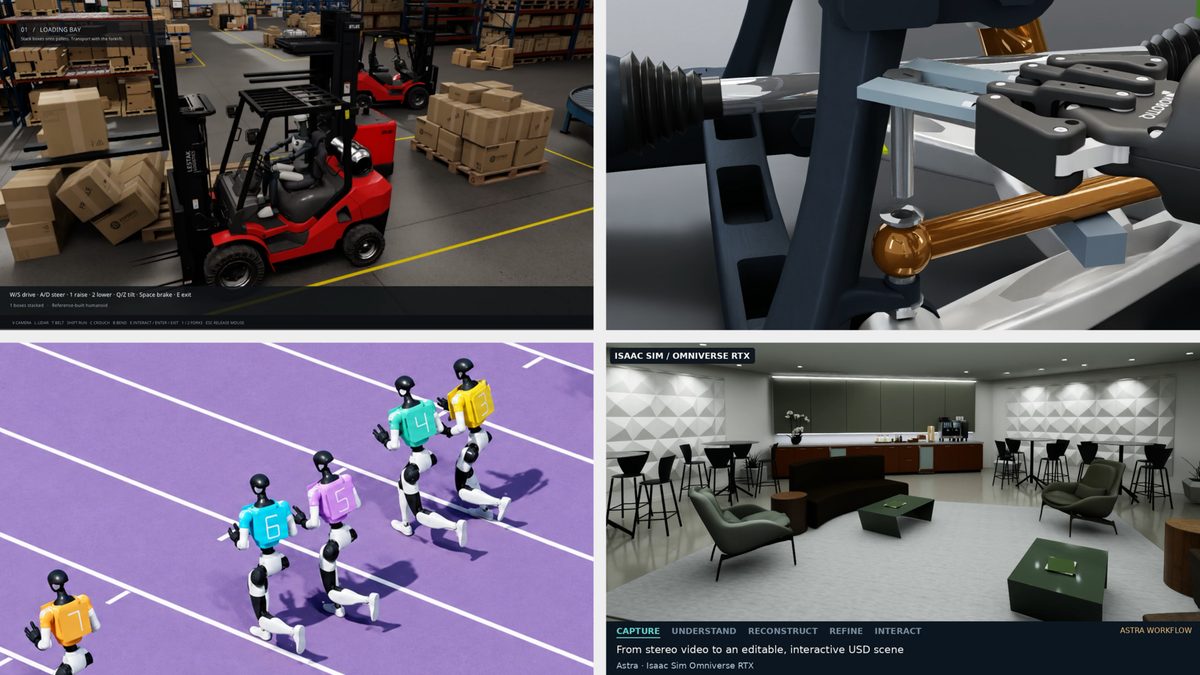
Developers are leveraging frontier AI agents, including models like GPT-6 Astra and Claude Fable 5, alongside NVIDIA Omniverse libraries to automate the generation and validation of physical 3D simulations. By translating natural-language instructions into application code, these agents connect GPU-accelerated physics, rendering, and sensor simulation tools for robotics and autonomous vehicle testing.
Projects led by NVIDIA technical teams demonstrate significant workflow acceleration across multiple domains. Omniverse product manager Frank DeLise used Astra to rapidly construct an interactive humanoid warehouse simulator, while manager Doyub Kim built a reusable autonomous driving prototype on San Francisco’s Market Street. In another validation experiment, agents autonomously created and calibrated digital twins against real-world camera and LiDAR datasets over three days.
By leveraging automated scene generation and sensor validation, teams can evaluate how downstream AI driving and control models react to synthetic environments. This workflow allows developers to run precise, KPI-driven comparisons across variable lighting and physical conditions before deploying physical hardware.
Why it matters
AI agents drastically reduce the time required to build complex 3D simulation environments for hardware.
Automated calibration between simulated sensors and real-world data speeds up physical AI development.
Enables rapid, high-consequence scenario testing for autonomous vehicles and robotics without manual coding.
Source: blogs.nvidia.com