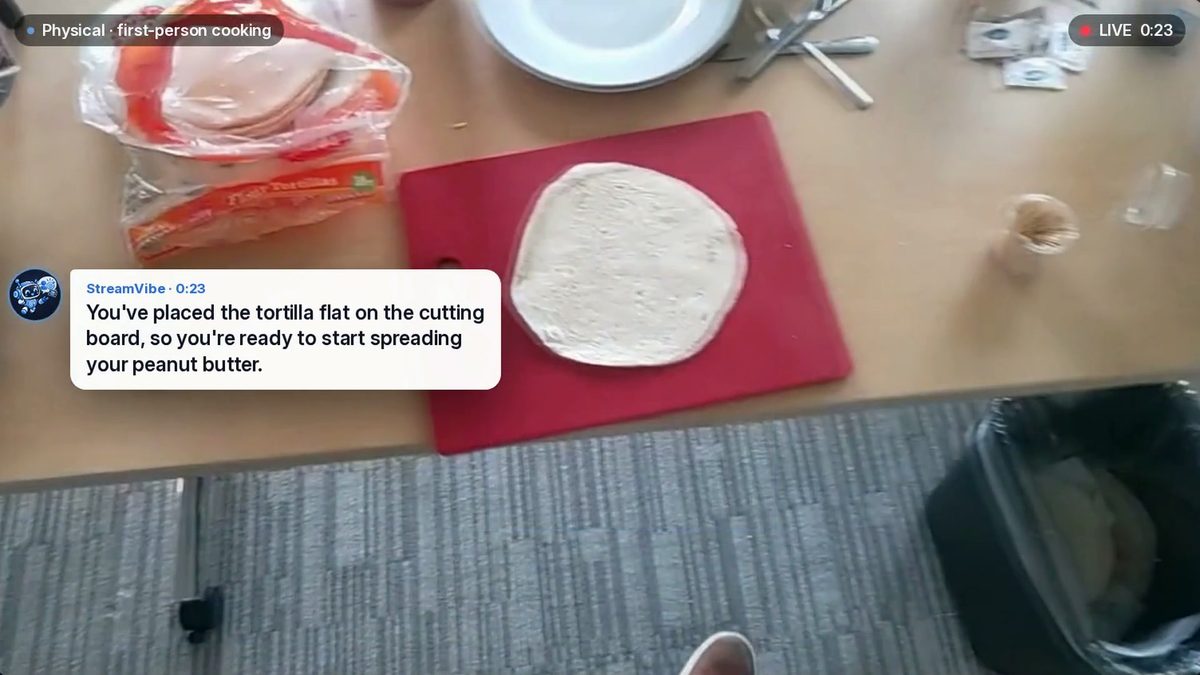
A research team led by Google, alongside collaborators from Stanford and Oxford, has unveiled StreamVibe, a system designed to help video AI agents decide when to proactively intervene during user tasks. To address the challenge of tracking implicit user needs during real-world activities like cooking or assembly, the team constructed a benchmark comprising 4,100 examples spanning over 183 hours of video content.
Alongside the benchmark, researchers presented StreamVibe-VL, a fine-tuned model built on Alibaba’s Qwen3.5-9B. Utilizing a two-stage training approach with reinforcement learning alongside a dedicated memory module, the system evaluates context every second to determine whether to remain silent or offer guidance. According to the paper, StreamVibe-VL yielded a 10.7% improvement in response timing and quality over baseline open-source models.
Despite these gains, the study highlights severe limitations in modern multimodal systems over extended interactions. In video sequences exceeding five minutes or involving altered user instructions, performance dropped by up to 61.5% across all tested models—including Google’s proprietary Gemini 3.8 Flash—as historical reasoning errors compounded over time.
Why it matters
Highlights persistent context window and memory failure modes in multimodal LLMs processing long video streams.
Establishes new RL-based training methods for reducing unwanted interruptions in proactive real-time AI assistants.
Provides foundational benchmarks for startups building spatial computing, robotics, and hands-free computer vision tools.
Source: the-decoder.com