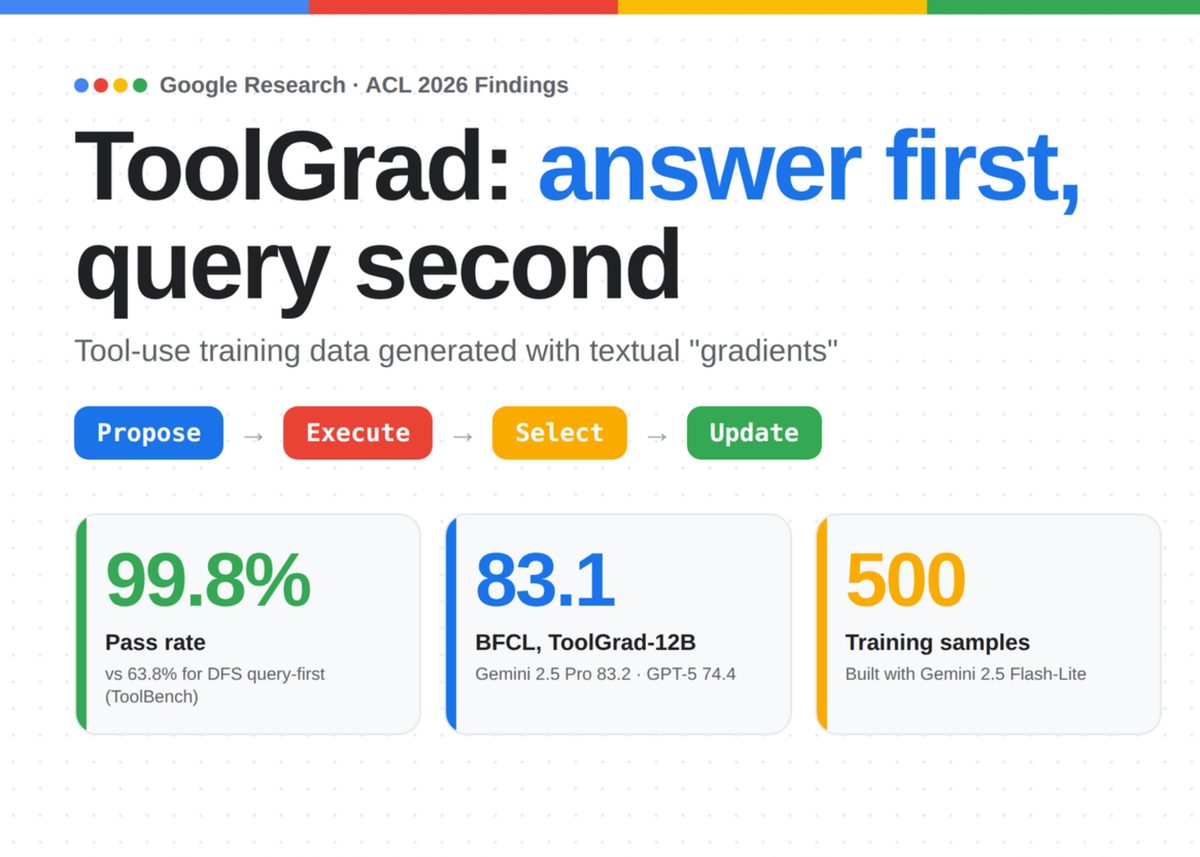
Researchers from Google, the University of Tokyo, RIKEN AIP, and Tohoku University introduced ToolGrad, an open-source framework designed to automate synthetic dataset creation for tool-using AI models. Inverting traditional pipelines that start with a user query, ToolGrad first constructs a verified API execution chain and then generates a matching user instruction. The method achieved a 99.8% success rate during data generation on the ToolBench database.
Using just 500 samples generated via Gemini 2.5 Flash-Lite, the researchers fine-tuned open-weight Gemma-3 models (1B, 4B, and 12B parameters). On the Berkeley Function Calling Leaderboard, these fine-tuned smaller models achieved performance competitive with frontier proprietary systems, demonstrating high sample efficiency for specialized function-calling tasks.
The full repository is licensed under Apache-2.0, with code, PyPI packages, and the ToolGrad-500 dataset made publicly available alongside weight checkpoints on Hugging Face. Evaluation scripts were verified running inference on a single NVIDIA A100 GPU.
Why it matters
Synthetic data pipelines that reverse workflow generation can dramatically cut model training costs while improving functional output quality.
Small open-weights models fine-tuned on hyper-specific tool-use data can rival proprietary frontier LLMs on complex API execution tasks.
ToolGrad provides developers an immediate, open-source toolchain to boost small model reliability for local agent workflows.
Source: marktechpost.com