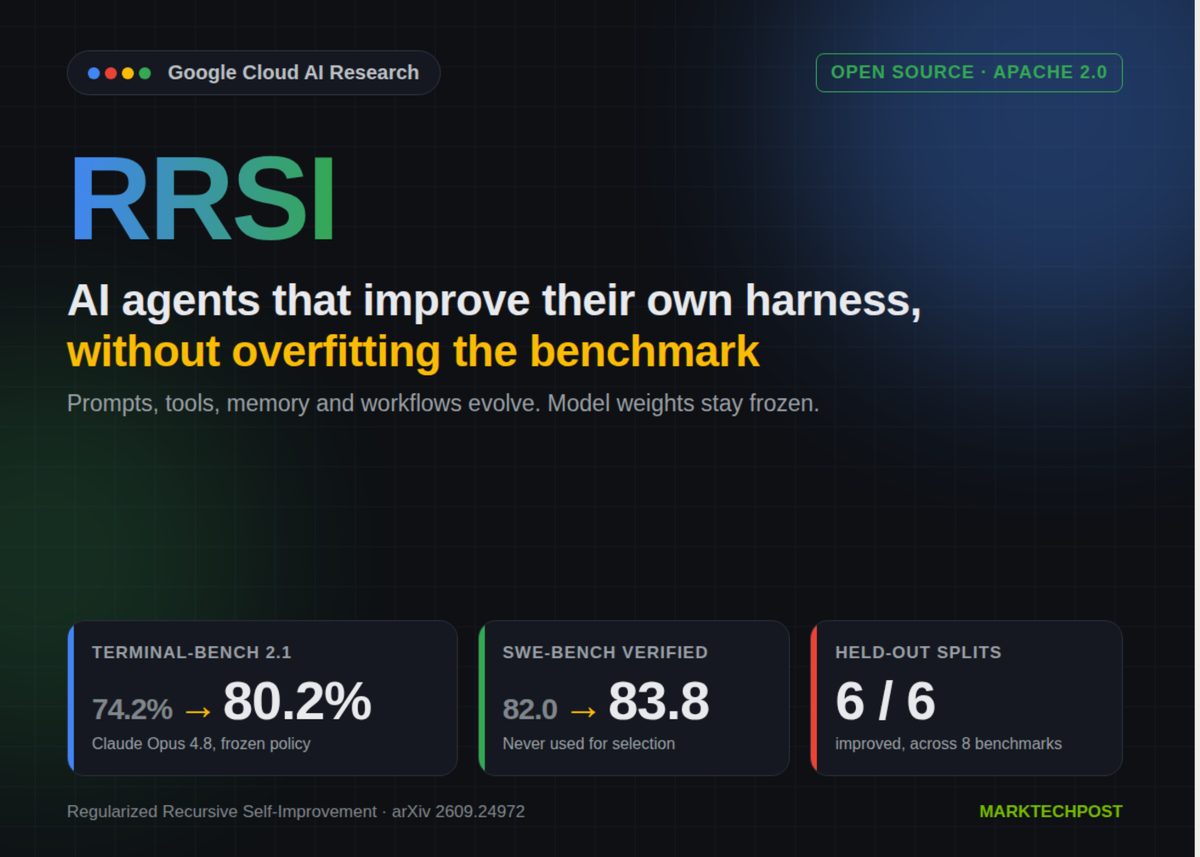
Researchers from Google Cloud AI, UNC-Chapel Hill, Stanford, and Washington University in St. Louis have open-sourced Regularized Recursive Self-Improvement (RRSI). The framework enables large language model agents to iteratively rewrite their own execution harnesses—including prompts, memory structures, control flows, and tool integration—without modifying underlying model weights.
To prevent the agent from overfitting to specific evaluation tasks, RRSI applies regularized search constraints analogous to L0, L1, and L2 mathematical regularizers. This setup limits unconstrained complexity growth and noise chasing, ensuring performance improvements successfully transfer to unseen evaluation sets.
When tested using Gemini 3.5 Flash as the underlying policy model, RRSI increased agent task performance on Terminal-Bench 2.1 from 64.6 to 78.7 and improved SWE-bench Verified performance from 76.8 to 79.0. Additionally, the regularized optimization loop reduced token consumption per trial by more than 30 percent compared to unregularized harness evolution.
Why it matters
Enables significant performance improvements in agentic workflows without the high compute cost of fine-tuning underlying model weights.
Solves harness overfitting, allowing enterprise developers to automatically optimize prompt and tool structures for out-of-distribution tasks.
Reduces token overhead and operational costs for complex multi-step developer tools and software engineering agents.
Source: marktechpost.com