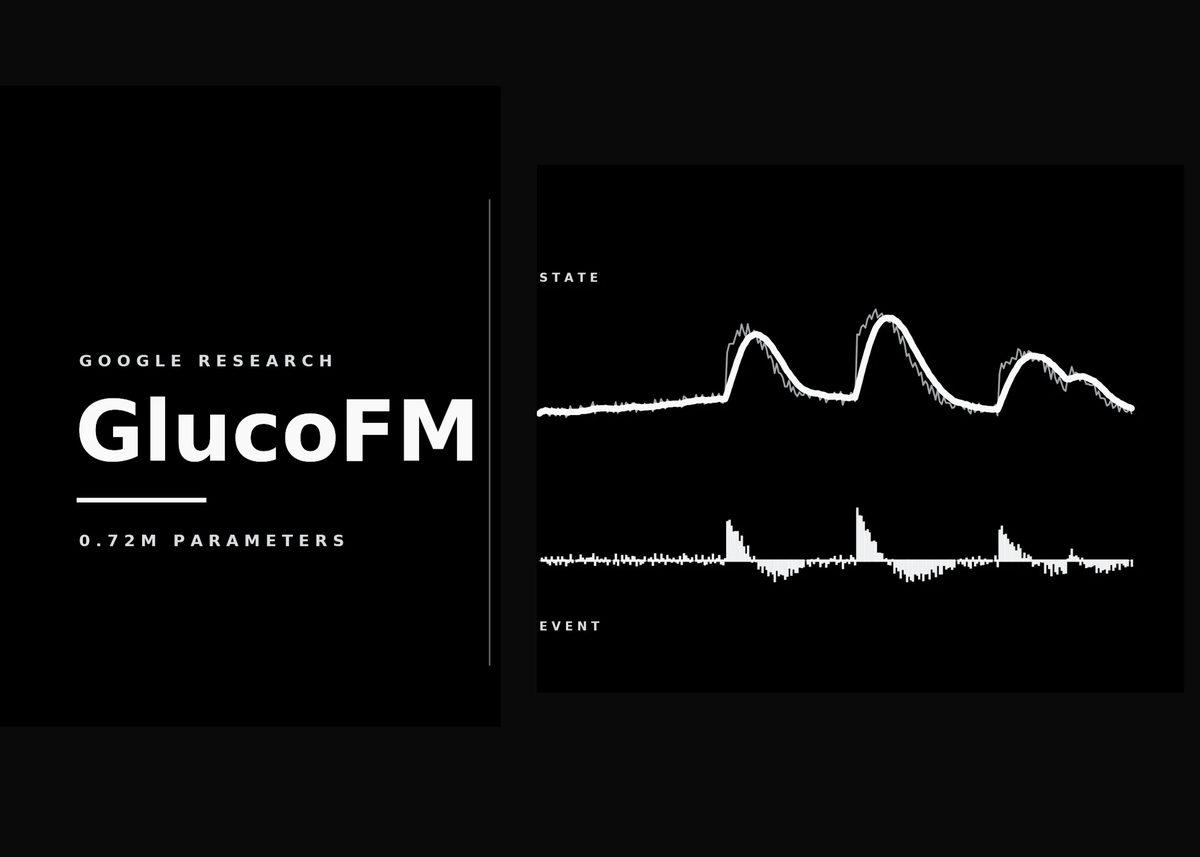
Google Research and UNSW Sydney have introduced GlucoFM, a 0.72-million parameter self-supervised foundation model designed specifically for processing continuous glucose monitoring (CGM) data. Unlike traditional single-sequence approaches, GlucoFM decomposes glucose traces into a slow physiological state stream and a transient event stream using a causal, mask-aware Gaussian filter before processing them through a 3-layer Transformer.
Pretrained on 109,066 hours of unlabeled CGM data across 477 subjects using a single NVIDIA H100 GPU, the model recorded a 58.8 task-averaged PR-AUC across 14 benchmark evaluations, outperforming specialized baselines. The architecture maintains missing observation masks end-to-end and uses Joint-Embedding Predictive Architecture (JEPA) style objectives to predict latent state dynamics over 24-hour windows.
The authors emphasize that GlucoFM is strictly a research prototype and lacks regulatory approval for clinical use. However, the model’s small footprint allows 24-hour inference windows to run efficiently on basic CPU containers or edge devices, offering an accessible lightweight architecture for digital health developers.
Why it matters
Lightweight, specialized JEPAs offer superior performance over massive general models for specialized time-series biological data.
Sub-million parameter models drastically reduce compute requirements, enabling on-device inference for continuous health monitoring.
Self-supervised pretraining strategies mitigate the high cost and scarcity of annotated medical datasets.
Source: marktechpost.com