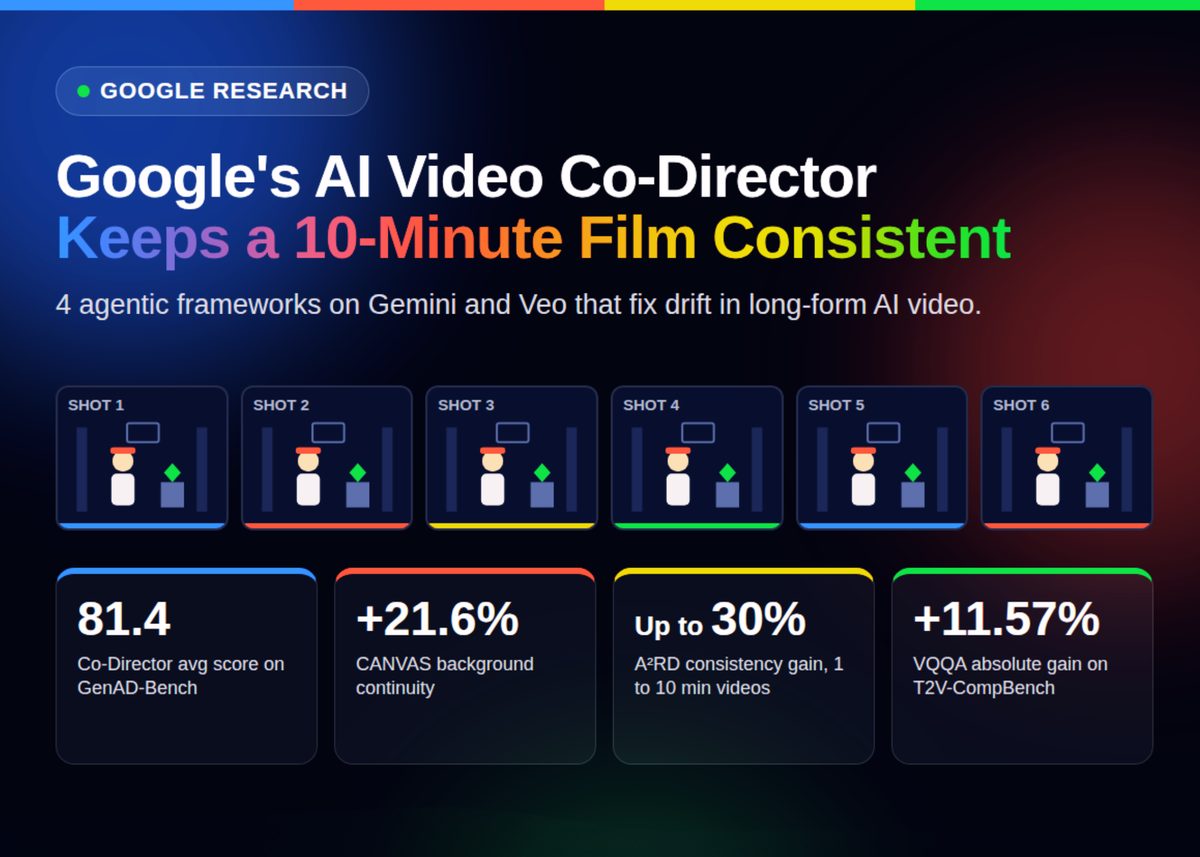
Google Research has unveiled an AI video co-director architecture designed to enable coherent, minutes-long video generation. The system addresses common failures in multi-shot video pipelines, specifically semantic drift and cascading errors where visual assets like attire or props shift or corrupt subsequent scenes. Sitting on top of models like Gemini and Veo, the model-agnostic system uses a combination of agentic frameworks to manage narrative structure, keyframes, and visual continuity.
Accepted at major AI conferences including COLM 2026 and EMNLP 2026, the architecture incorporates specialized components such as CANVAS, which tracks entity states and visual anchors across scenes, and A²RD, a training-free autoregressive diffusion setup. To evaluate these capabilities, Google introduced three new benchmark datasets—GenAD-Bench, HardContinuityBench, and LVBench-C—focused on testing long-context visual stability and prop state retention.
The framework represents a step forward for generative media production by attempting to automate the complex orchestration involved in multi-shot video creation. All output inherits digital watermarking via SynthID from the underlying base models.
Why it matters
Provides a blueprint for solving identity drift and consistency errors in long-form generative video pipelines.
Demonstrates how orchestration layers can build multi-minute video capabilities without retraining base diffusion models.
Establishes new benchmarking standards for evaluating long-context entity retention in commercial AI video generation.
Source: marktechpost.com