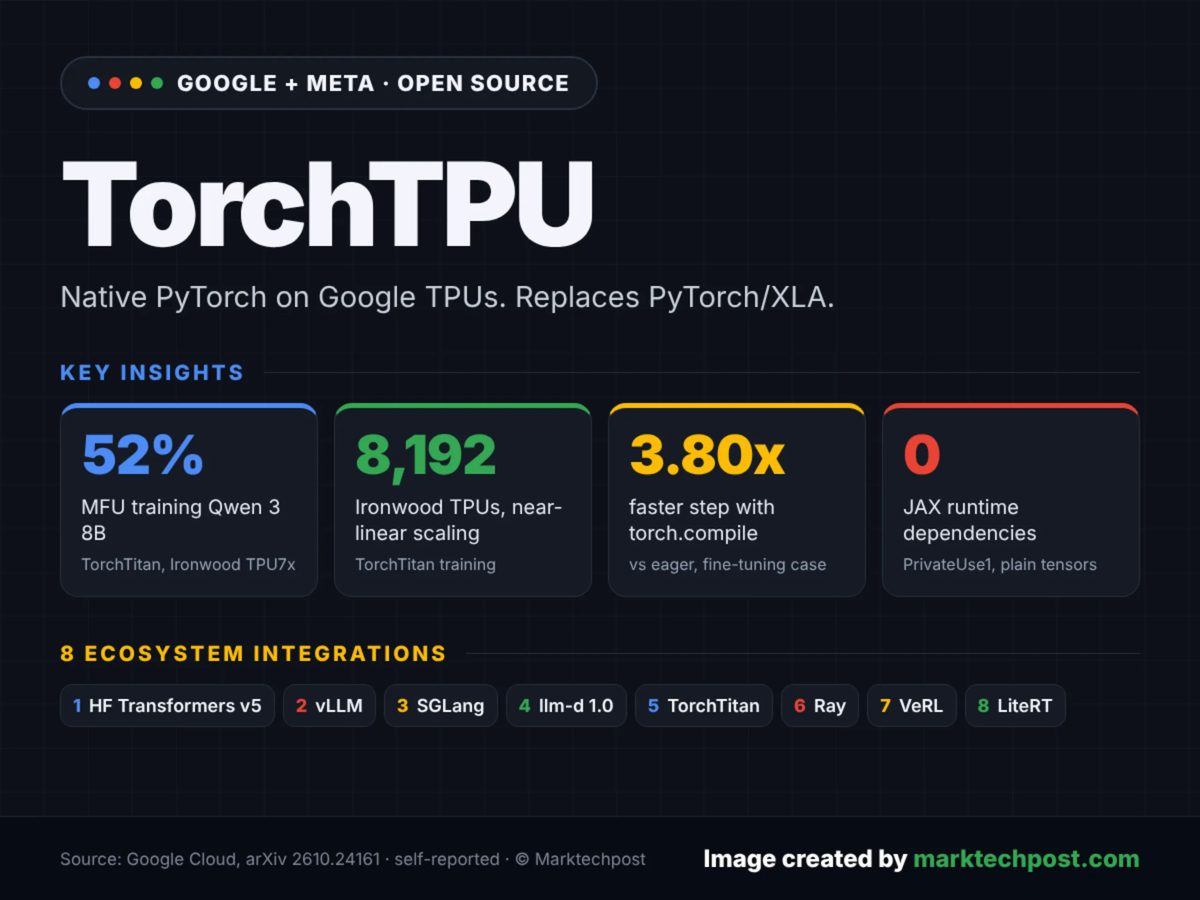
Google, in collaboration with Meta’s PyTorch team, has open-sourced TorchTPU, a native PyTorch hardware backend engineered specifically for Cloud TPUs. Formally announced at the PyTorch Conference 2026, the software integrates directly into PyTorch using the PrivateUse1 interface, enabling developers to target TPU hardware using standard tensor commands rather than specialized lazy-graph wrappers. Google recommends TorchTPU to replace the older PyTorch/XLA library for all new computing workloads.
TorchTPU eliminates previous development bottlenecks by supporting dynamic execution models alongside direct tensor mutations and view preservation. To achieve high execution performance, the software utilizes PyTorch Dynamo graph capture to compile code through StableHLO and OpenXLA, while caching compiled executables across system job restarts. The backend supports standard distributed training paradigms, including Fully Sharded Data Parallel (FSDP2) and custom tile kernels.
By integrating TPUs as a primary supported device within the core PyTorch ecosystem, Google and Meta aim to reduce developer friction when training and serving large models on non-GPU hardware. Detailed installation documentation and configuration guides have been made available via public repositories.
Why it matters
AI engineers can run standard PyTorch code on Cloud TPUs without rewriting models for legacy PyTorch/XLA translation layers.
Enterprise teams gain greater flexibility to execute large-scale distributed training on alternative accelerator hardware alongside existing GPU clusters.
Source: marktechpost.com