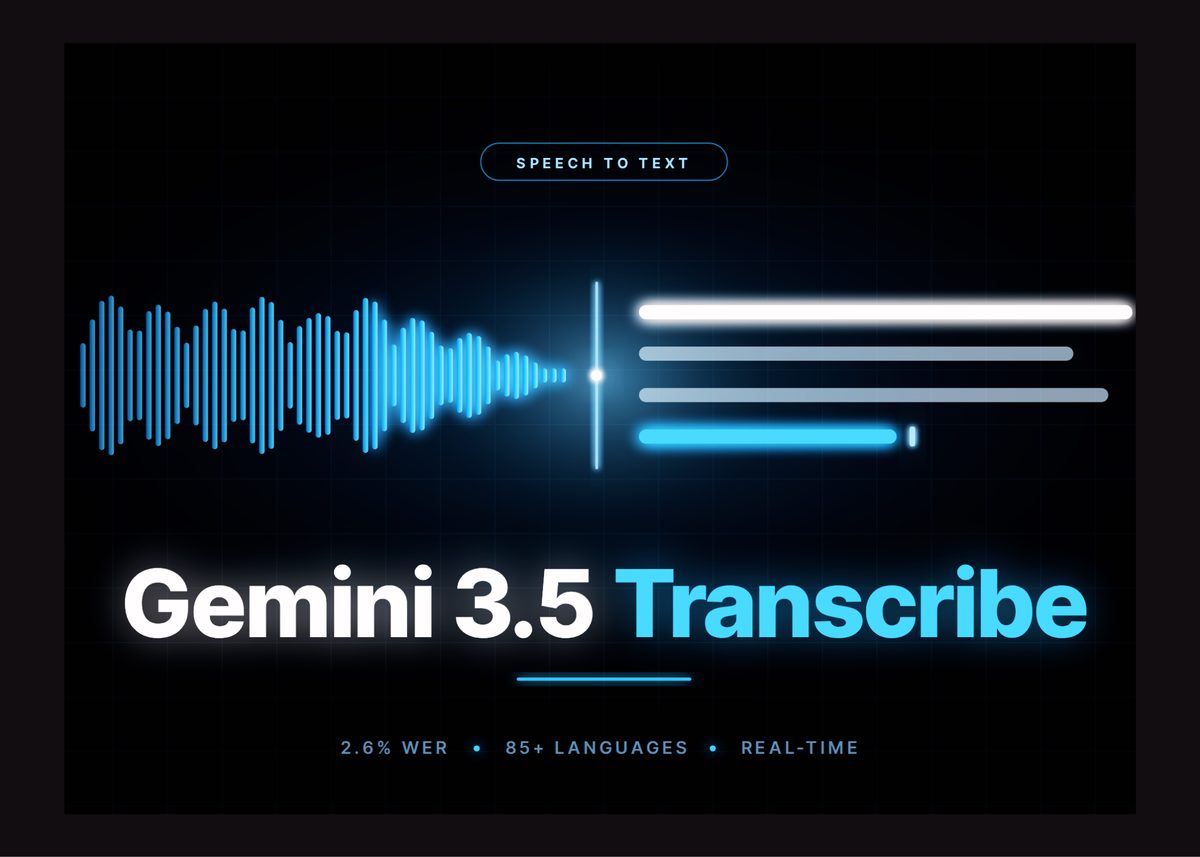
Google has launched Gemini 3.5 Transcribe, a dedicated speech-to-text model designed for real-time voice interfaces and asynchronous audio processing. According to benchmarks by Artificial Analysis, the model achieves an average word error rate (WER) of 2.6% for pre-recorded audio and 4.0% for live streaming. The system features automatic language detection and code-switching across more than 85 locales, outperforming Google’s previous Chirp 3 architecture with a 70% reduction in time to final transcription.
The release splits capabilities across two distinct API endpoints: gemini-3.5-transcribe via the Interactions API for recorded audio, and gemini-3.5-transcribe-live via the Live API for sub-second streaming. The Live API accepts 16kHz PCM audio in 100ms chunks but caps continuous sessions at 10 minutes and omits speaker diarization. Conversely, the Interactions API supports up to 1,000 custom vocabulary terms, diarization, and precise timestamps, though standard file limits drop from one hour to 30 minutes when advanced features are enabled.
Both endpoints offer ‘verbatim’ and ‘smart’ output modes, the latter automatically filtering verbal disfluencies and self-corrections. The managed API service has already been integrated into developer platforms like LiveKit and Pipecat, alongside Google’s internal applications on Android and macOS.
Why it matters
Delivers ultra-low latency and low error rates for developers building real-time conversational AI voice agents.
Requires developers to choose between precise word timestamps and smart transcript formatting due to rigid API tradeoffs.
Source: marktechpost.com