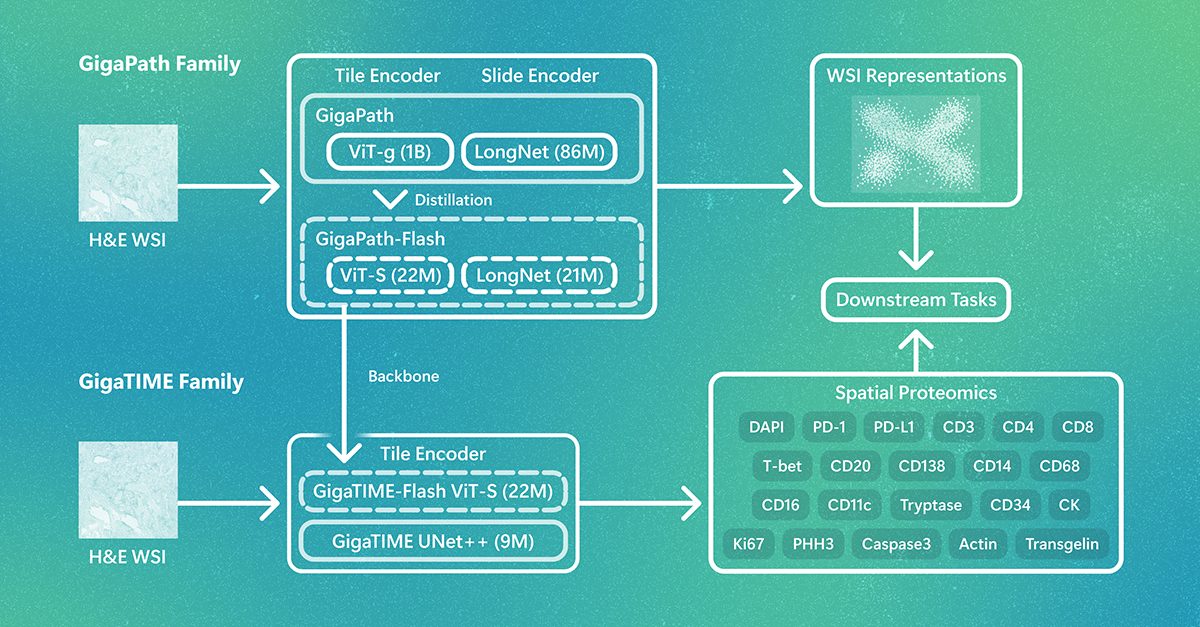
Microsoft researchers have released GigaPath-Flash and GigaTIME-Flash, two open-source foundation models designed to accelerate digital pathology and biological discovery. Distributed under the Apache 2.0 license, the models adapt Microsoft’s previous whole-slide and tumor microenvironment architectures to significantly lower the computational resources required for gigapixel image analysis.
The Flash models utilize an efficient computational backbone featuring a compact 22-million-parameter Vision Transformer tile encoder distilled from the original billion-parameter GigaPath model, paired with a 21-million-parameter LongNet slide encoder. GigaTIME-Flash further extends virtual spatial proteomics capability, translating routine H&E stain slides into multi-channel cell maps to model complex tumor microenvironments without high operational overhead.
Microsoft highlighted that while these open research models are not validated for direct clinical diagnosis or patient care decisions, their reduced computational requirements enable researchers to analyze larger patient cohorts and perform repeated hypothesis testing efficiently across population-scale datasets.
Why it matters
Distilled open-source foundation models lower the compute cost barrier for high-resolution biological and scientific image analysis.
Apache 2.0 licensing allows startups and academic labs to integrate advanced spatial pathology tools into commercial and scientific pipelines.
Demonstrates model distillation techniques effectively scaling complex multi-modal analysis to population-sized research projects.
Source: microsoft.com