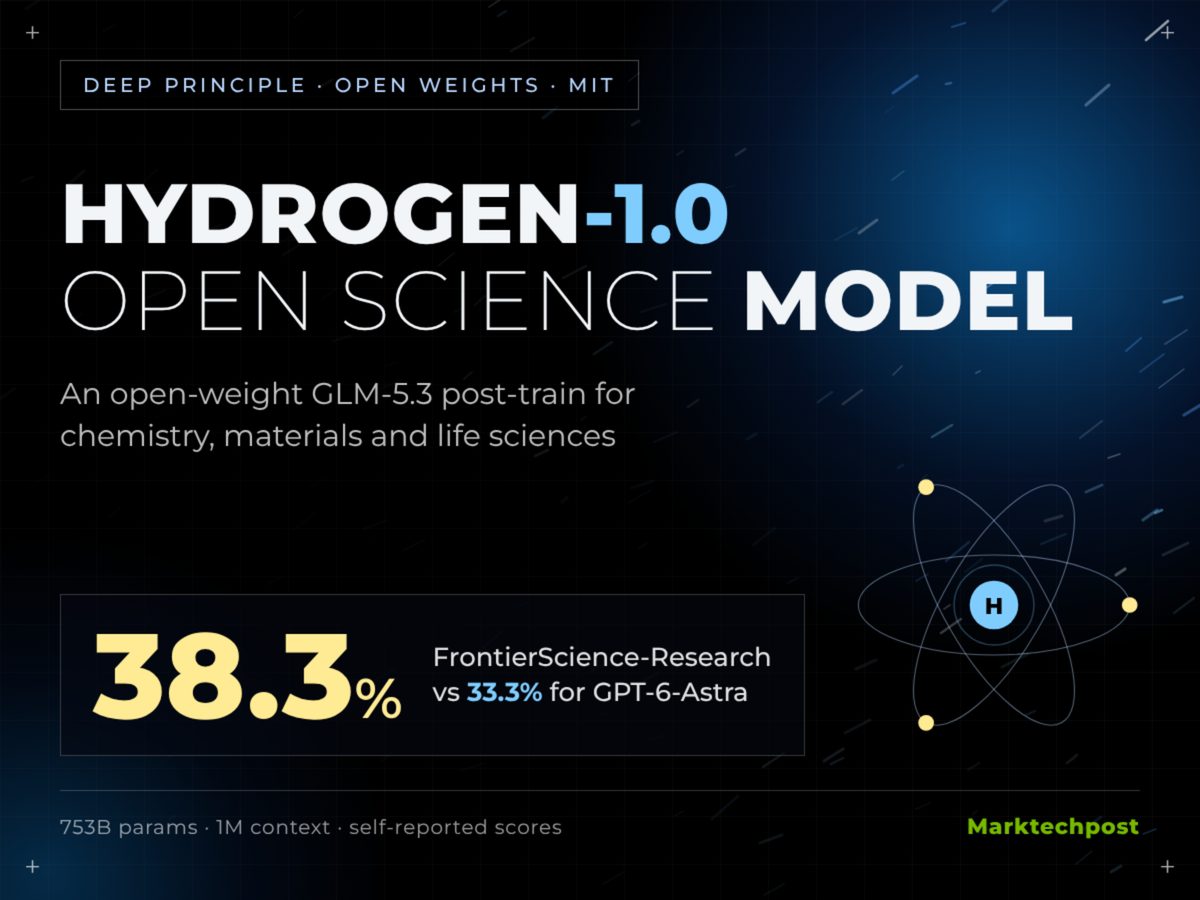
Hangzhou-based AI materials startup Deep Principle has launched Hydrogen-1.0, an open-weight 753-billion parameter model specialized for scientific discovery across chemistry, materials science, and life sciences. Built by post-training Z.ai’s GLM-5.3 using domain data, lab records, and synthetic discovery trajectories, the model is distributed under the open MIT License on Hugging Face and ModelScope.
According to Deep Principle, Hydrogen-1.0 achieved 93.0% on the GPQA-Diamond benchmark and outperformed proprietary models like GPT-6-Astra on internal scientific tasks, including multi-round transition metal complex design and experiment planning. The model’s training pipeline combines supervised fine-tuning and reinforcement learning using dynamic sparse attention built on Megatron and SGLang infrastructure, supporting deployability across NVIDIA and AMD GPU hardware via BF16 and blockwise FP8 precision formats.
The release provides researchers and enterprises with an inspectable, open-weight alternative to proprietary scientific models. Demonstrated capabilities range from self-correcting GROMACS molecular dynamics scripts to automated JSON protocol compilation for laboratory execution platforms.
Why it matters
Delivers an open-weight alternative to proprietary frontier models for specialized bio-tech, chemistry, and material science workloads.
Demonstrates high-performance post-training strategies (SFT+RL) tailored for complex multi-step reasoning and automated lab tools.
Provides cross-hardware infrastructure support (NVIDIA CUDA and AMD ROCm) for cost-effective enterprise research serving.
Source: marktechpost.com