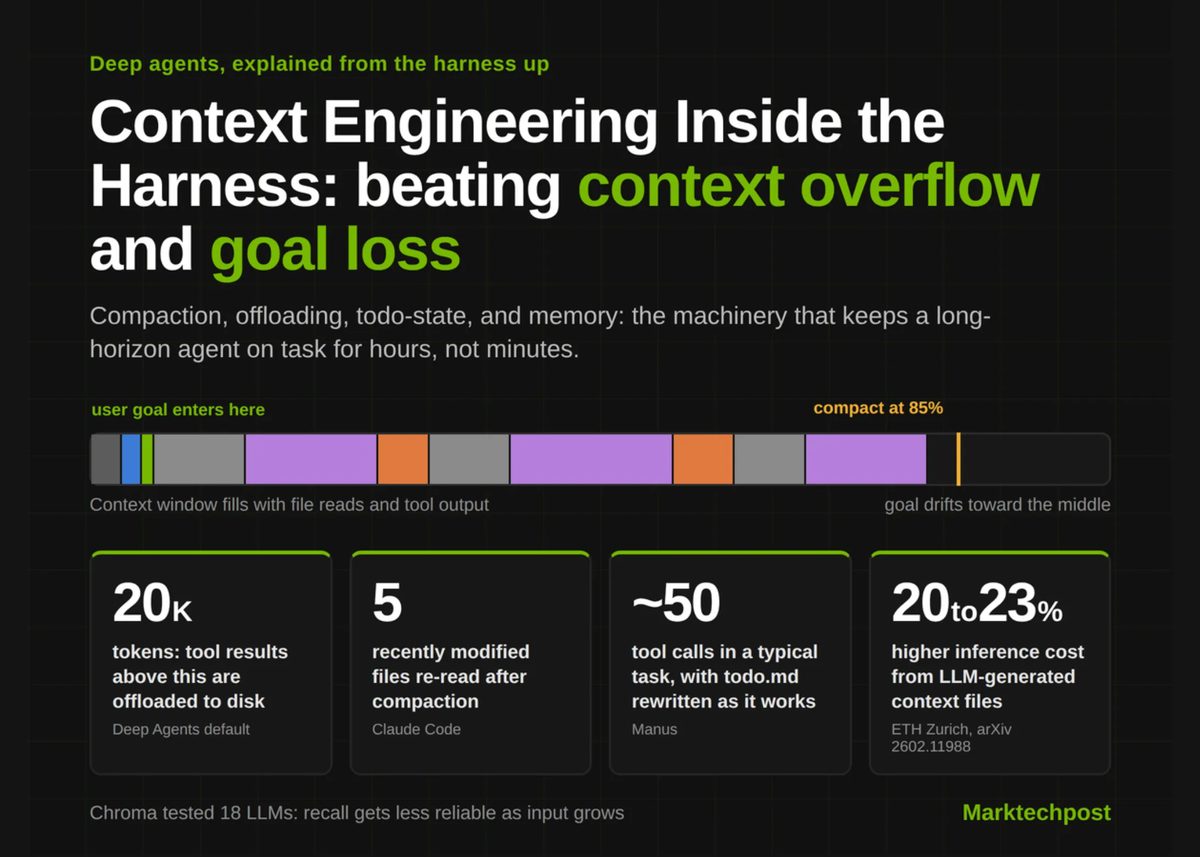
Long-running autonomous agents frequently fail due to context overflow and goal loss when executing complex workflows over dozens of tool calls. According to AWS Samples guidelines and industry research, simply expanding model context windows is insufficient due to attention degradation and token cost accumulation. To resolve these failure modes, developers are shifting focus from underlying LLMs to specialized harness layers that govern context lifecycle management.
Modern agent harnesses—including LangChain Deep Agents, Claude Code, Manus, and Amazon Bedrock AgentCore—employ four primary mechanisms to stabilize long-horizon tasks: offloading, subagent isolation, automatic compaction, and todo-state management. For example, Deep Agents automatically offloads tool responses exceeding 20,000 tokens to the filesystem, while Claude Code caps auto-memory loads and defers tool schemas until explicitly requested.
Architectural subagent delegation further prevents context rot by isolating exploration compute. In multi-agent systems such as AWS AgentCore, subagents run independent tasks within isolated micro-VMs and return only distilled summaries to the main coordinator, significantly reducing total context pressure while maintaining overall task focus.
Why it matters
Long-horizon agent stability depends on external harness engineering—such as offloading and schema deferral—rather than reliance on raw context window size.
Architectural subagent isolation reduces context degradation by returning short summaries while running search and execution in isolated micro-VMs.
Engineers can optimize agent token usage and prevent context decay using explicit compaction thresholds and hard offloading rules.
Source: marktechpost.com