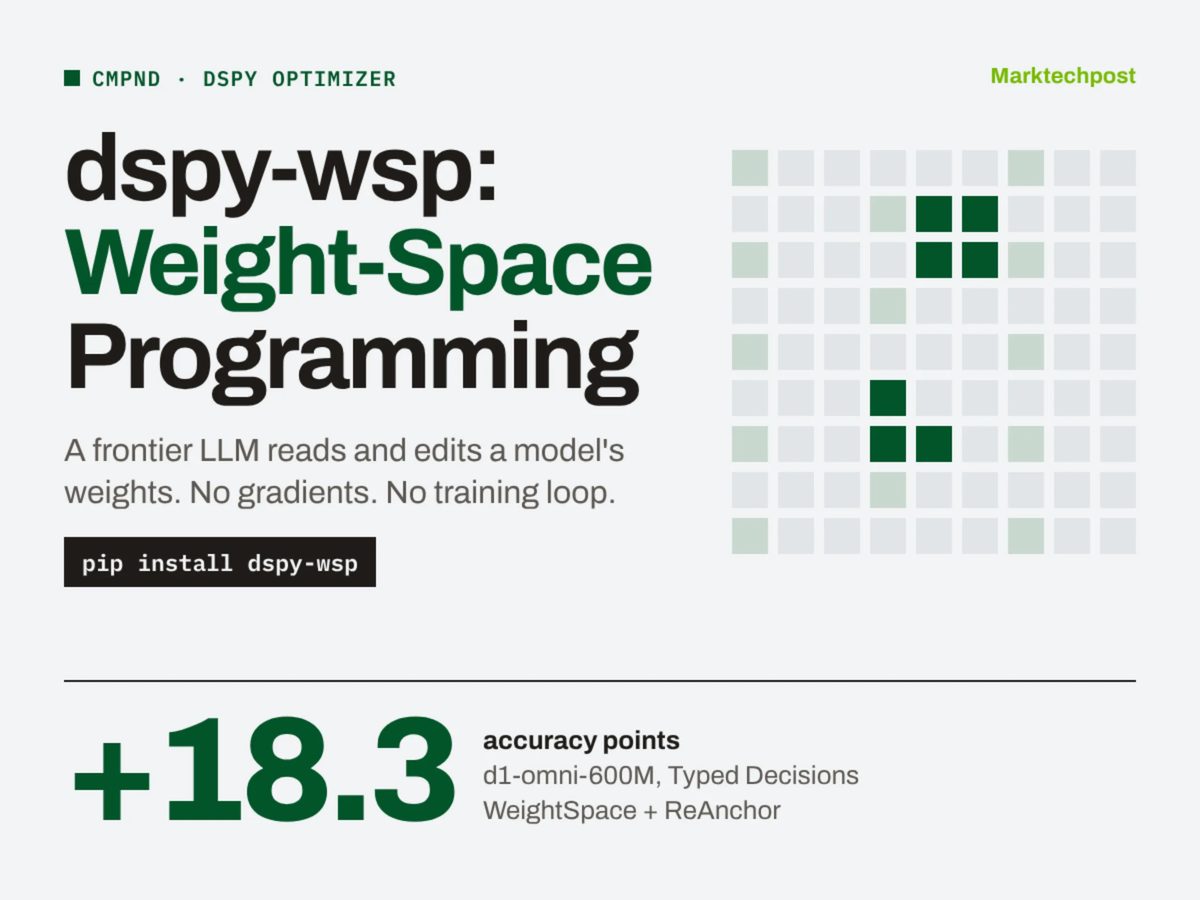
Cmpnd has launched dspy-wsp, a prototype optimizer that implements weight-space programming (WSP) for the DSPy framework. Based on MIT research, WSP enables a frontier language model to directly read and edit another neural network’s weight tensors to meet natural language goals without gradients, training loops, or fine-tuning datasets.
The dspy-wsp tool integrates as a standard WeightSpace optimizer within DSPy programs. In Cmpnd’s testing using GPT-6-Astra as the editor model, spends of $5 to $10 in API calls yielded targeted weight edits across every tested decision model, allowing local deployment of modified models in place of hosted APIs.
While effective at modifying specific components like decision heads, the underlying research indicates structural limits. For instance, edits to Gemma 3 270M failed to provide meaningful gains on MATH-500, showing that weight-space editing can remove internal processing obstacles but cannot introduce entirely missing model capabilities.
Why it matters
Developers can now optimize local model weights directly via prompt-based LLM reasoning using standard DSPy workflows.
Founders can reduce reliance on hosted APIs by using low-cost LLM passes to patch and deploy lightweight local models.
Operators should recognize WSP’s limitations: it fine-tunes existing architecture behaviors but cannot add unlearned skills.
Source: marktechpost.com