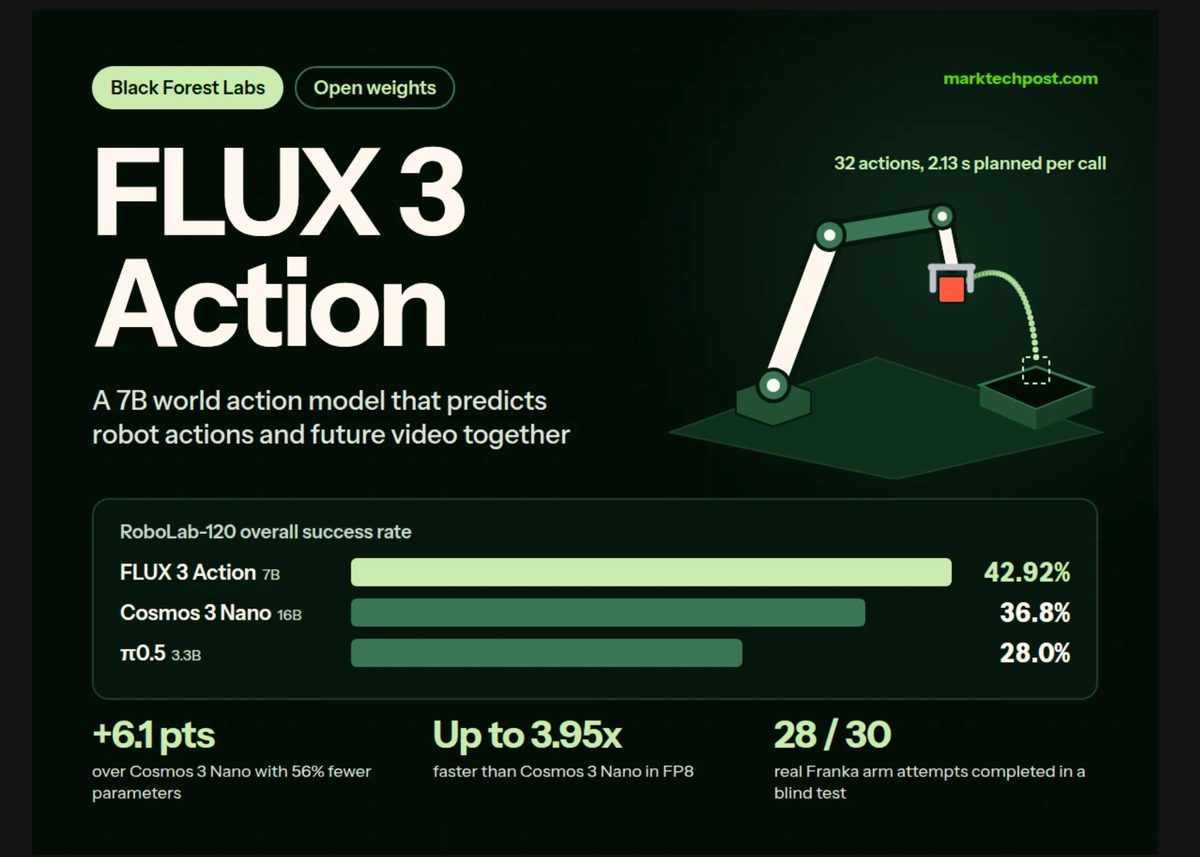
Black Forest Labs has released FLUX 3 Action, a 7B open-weights World Action Model (WAM) designed for robot control. The model processes camera frames, robot state, and text instructions to concurrently predict future video frames and robot actions. It achieved a first-place ranking on the RoboLab-120 leaderboard with a 42.92% task success rate, outperforming NVIDIA’s Cosmos 3 Nano and other competitor models.
Derived from the multimodal FLUX 3 backbone, the model was pretrained primarily on video data before undergoing midtraining with action-aligned video across 14 embodiments. BFL addresses the high computational cost typically associated with video-predicting WAMs by utilizing a smaller backbone and distillation, allowing it to achieve faster motion prediction speeds than competing models.
Deployable under the non-commercial FLUX Kommunity License, the DROID policy runs on H200, 24 GB consumer GPUs via FP8 quantization, and workstation hardware. Independent real-hardware testing by Positronic Robotics on a Franka arm validated these simulation results, with FLUX 3 Action completing 28 out of 30 physical task attempts.
Why it matters
Open-weights release provides robotics startups with a state-of-the-art 7B world action model that outpaces proprietary benchmarks.
Distillation and quantization allow real-time 15 Hz inference on 24 GB consumer and workstation GPUs, lowering hardware deployment barriers.
Demonstrates that pretraining on mixed video data dramatically improves task success rates compared to training solely on domain-specific robot demonstrations.
Source: marktechpost.com