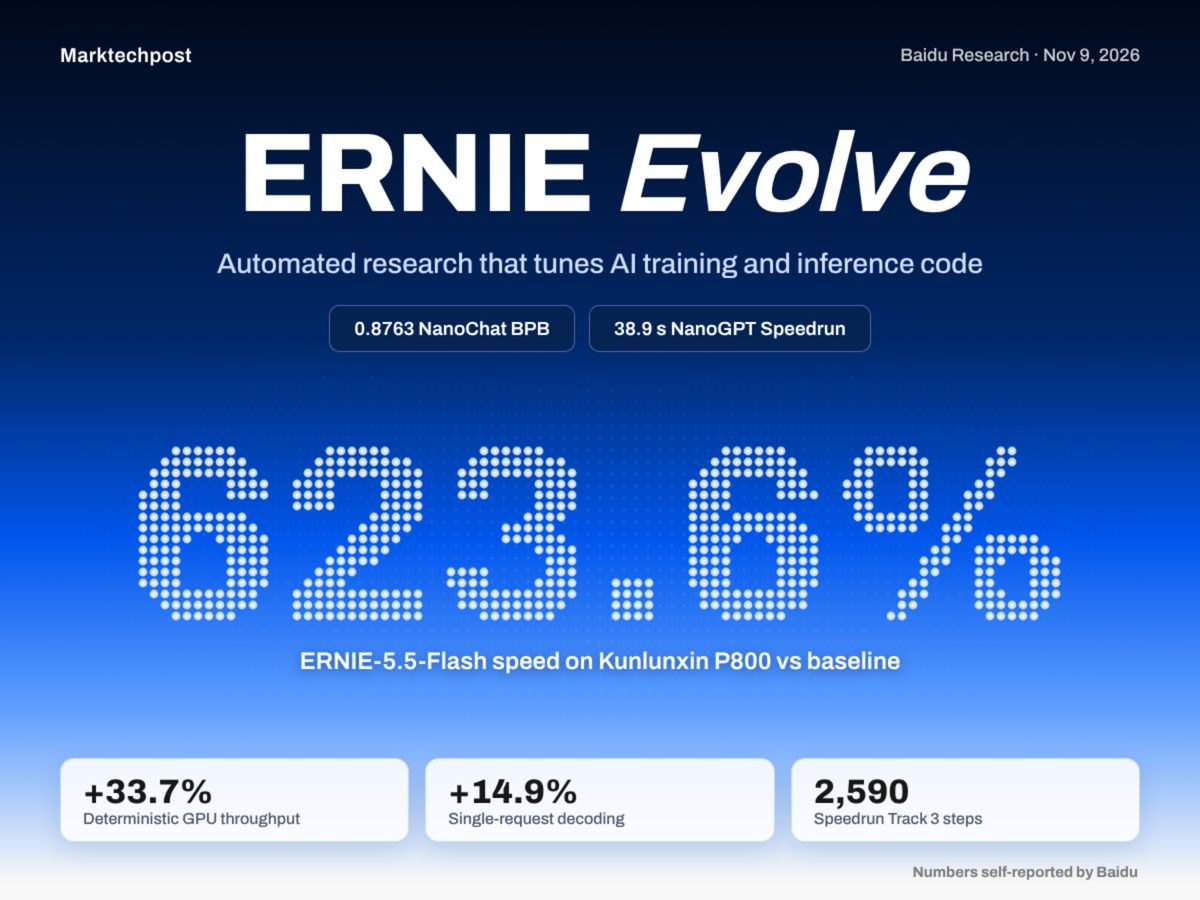
Baidu has announced ERNIE Evolve, an automated research framework aimed at accelerating AI model training and optimizing inference code. Given a targeted repository, performance metrics, and evaluation criteria, the system autonomously formulates research directions, writes code modifications, and executes experimental trials. Modifications are integrated only after passing automated reviewer and evaluation checks.
According to Baidu, the framework operates using two nested loops: an outer loop that selects research pathways and an inner loop that iteratively develops code within independent trees. Failed experiments are logged to prevent redundant iterations. Baidu verified the framework across multiple public benchmarks—including NanoChat AutoResearch and NanoGPT Speedrun—before deploying it to optimize live engineering tasks for its unreleased ERNIE-5.5-Flash model.
Baidu framed the release as a step toward practical recursive self-improvement, where AI tools directly refine the underlying software architecture used to build and deploy future models. The project code and benchmark results have been made publicly available on GitHub.
Why it matters
Automated code research systems can significantly reduce manual engineering cycles for AI model training and inference optimization.
Recursive self-improvement tooling is moving from theoretical research into enterprise infrastructure pipelines.
Development teams can leverage automated research agents to systematically optimize codebases against fixed measurable metrics.
Source: marktechpost.com