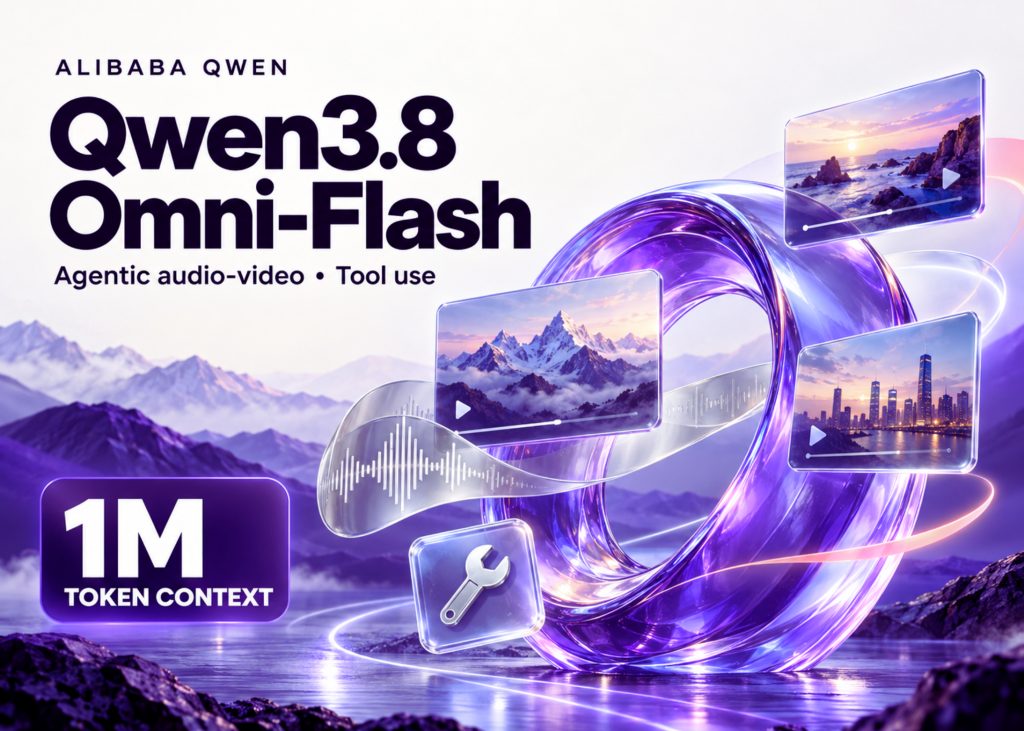
Alibaba’s Qwen team released Qwen3.8-Omni-Flash on September 18, 2026, marking its first omni-modal model optimized specifically for agentic execution. The model accepts text, image, audio, and video inputs, outputting text through hosted APIs on QwenCloud, Alibaba Cloud Model Studio, and Qwen Studio. Built on the Qwen3.8-Flash-Next architecture, the model features a 1-million-token context window with max input limits of 991,000 tokens and max reasoning capabilities up to 262,000 tokens.
According to the Qwen team, the model alters traditional multimodal processing by using an iterative search mechanism. Rather than processing entire video files sequentially, the agent dynamically selects relevant video and audio segments based on user queries. Internal benchmarks report that this targeted approach reduces token usage by 45.7% while increasing video question-answering accuracy on OmniVideoBench from 63.4 to 67.8.
Alongside the API launch, Alibaba open-sourced the Apache-2.0 licensed Qwen-MM-Plugins project to integrate multimodal skills into existing agent frameworks like Claude Code and Codex. QwenCloud pricing is set at $0.15 per million input tokens and $0.47 per million output tokens.
Why it matters
Dynamic coarse-to-fine media processing significantly slashes video token consumption and lowers inference operational costs.
API-first launches without open weights limit self-hosting flexibility, forcing reliance on proprietary cloud endpoints.
Standardized multimodal agent plugins make it easier to add audio-visual tool capabilities to existing code-focused agent harnesses.
Source: marktechpost.com