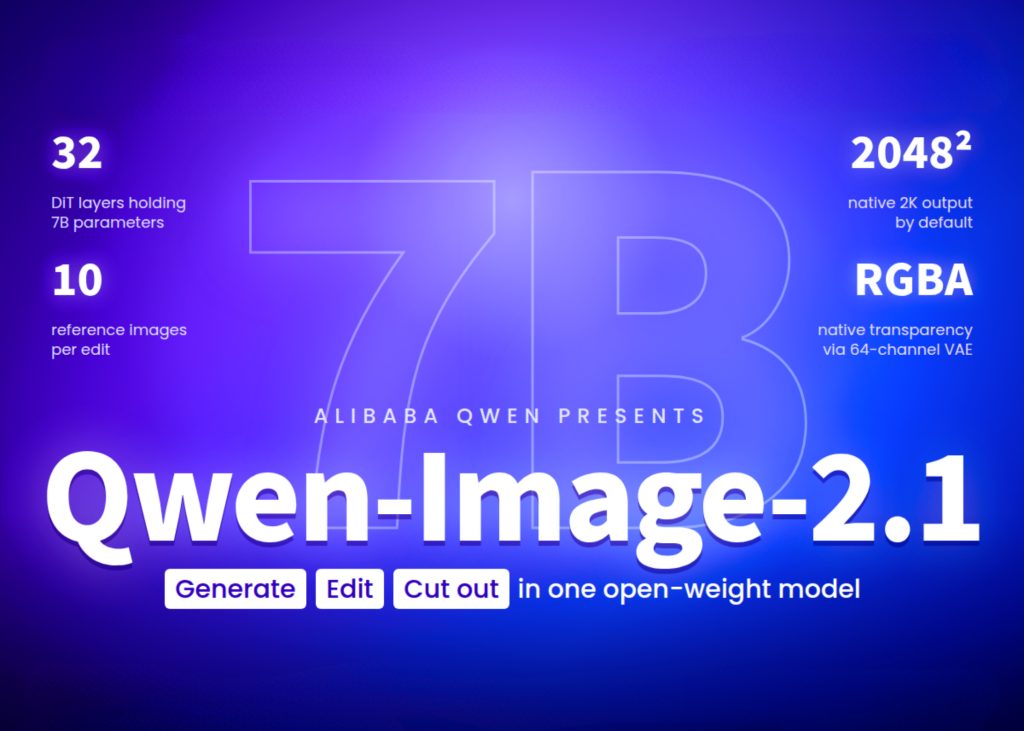
Alibaba’s Qwen team has officially released Qwen-Image-2.1, a 7-parameter open-weight visual model that unifies text-to-image generation, multi-reference editing, local edits, and transparent RGBA output into a single architecture. The model reduces operational footprint compared to its 20B predecessor released in August 2025, which required separate checkpoints for generation and editing. While the core Diffusion Transformer contains 7B parameters, the complete pipeline also loads an 8B Qwen3-VL text-visual encoder.
Architecturally, the model utilizes mixed-granularity attention to optimize inference efficiency. By placing condition prefixes before noisy latents, key-value caches are computed once at the initial step and reused across subsequent denoising steps, significantly reducing latency during multi-image editing tasks. Day-zero support covers key developer frameworks including Diffusers, ComfyUI, vLLM-Omni, SGLang, and AMD’s ROCm platform.
According to internal testing on Qwen-Image-Bench, Qwen-Image-2.1 achieved an overall score of 60.28, outperforming open-weight competitors like Nano Banana 2.0 and FLUX 2 Max. The weights are available for research and evaluation, though commercial deployment requires a separate license from Qwen.
Why it matters
Consolidates image creation and complex editing into a single open-weight checkpoint, lowering infrastructure complexity.
Prefix key-value caching optimizations drastically cut inference compute costs for multi-reference visual tasks.
Delivers top-tier open visual generation benchmarks, applying competitive pressure to closed commercial image APIs.
Source: marktechpost.com