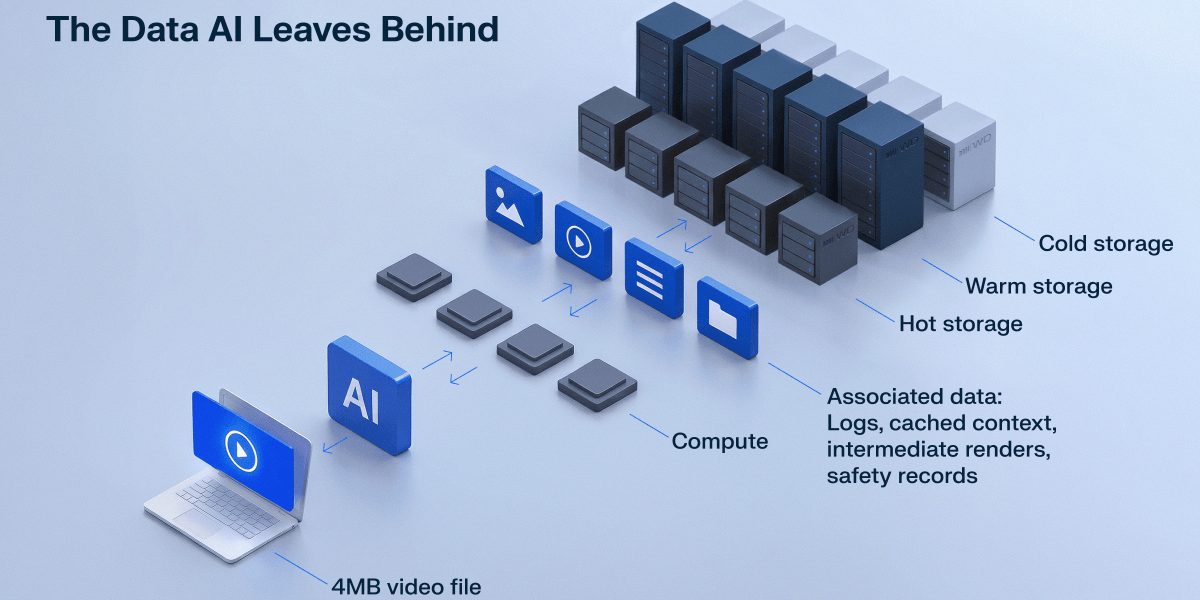
Rising adoption of generative AI inference is creating significant unbudgeted storage expenses across enterprise data centers. According to research from Western Digital, continuous inference workloads generate extensive logs, cached contexts, and safety records that far exceed initial output files. For example, an 8-second AI-generated video clip outputting a 3.97MB file creates over 500MB of backend data footprint.
Data retention demand is shifting overall infrastructure economics as inference scales across enterprise applications. McKinsey forecasts that AI inference demand will grow at a 35% compound annual growth rate through 2030, eventually accounting for over 40% of total data center capacity. A recent IDC survey indicates that nearly 95% of IT leaders experienced increased data volumes due to generative AI over the past year.
To prevent costly GPU idle time during data retrieval, organizations are forced to optimize their storage architecture. Enterprise IT departments are increasingly adopting hybrid storage strategies, utilizing high-capacity HDDs alongside fast retrieval systems to support retrieval-augmented generation and ongoing model evaluation without exceeding operational budgets.
Why it matters
Inference workloads accumulate persistent backend logs and context data that far outpace the size of initial outputs.
Fast storage architectures are essential to prevent expensive GPU idle time during retrieval-augmented generation and data loading.
Enterprise IT budgets must accommodate a forecasted 35% CAGR in inference storage growth through 2030.
Source: technologyreview.com