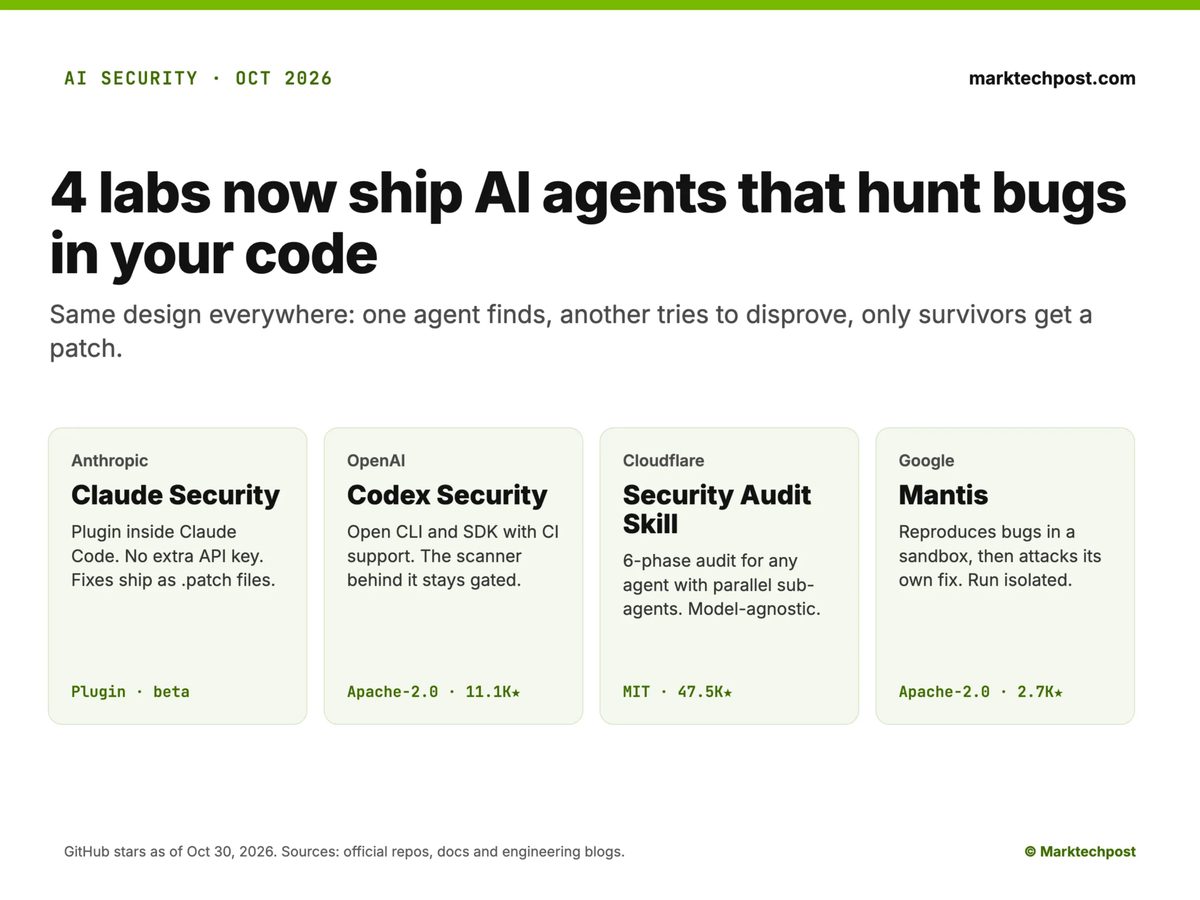
Anthropic, OpenAI, Cloudflare, and Google have all released AI agents focused on identifying and repairing security vulnerabilities in source code. Analysis of their technical documentation indicates an industry-wide convergence on multi-agent architectures that mandate a strict separation of duties between vulnerability detection and confirmation.
According to Google’s security research, unverified AI code scanning frequently produces true-positive rates below 7%, creating severe noise for human reviewers. To address this issue, modern frameworks enforce a rule where the agent reporting a potential bug is never permitted to verify it, requiring an independent disprover agent to validate findings before drafting patches.
These automated security capabilities are being integrated across developer workflows, ranging from local CLI tools to enterprise-hosted scanning suites. While access models vary across open-source tools and limited enterprise betas, the dual-agent pattern establishes a new baseline for automated code auditing.
Why it matters
Establishes multi-agent separation of duties as the standard design pattern to eliminate high false-positive rates in automated security scanning.
Integrates automated vulnerability discovery and patching directly into developer repositories via CLIs and plugin architectures.
Source: marktechpost.com