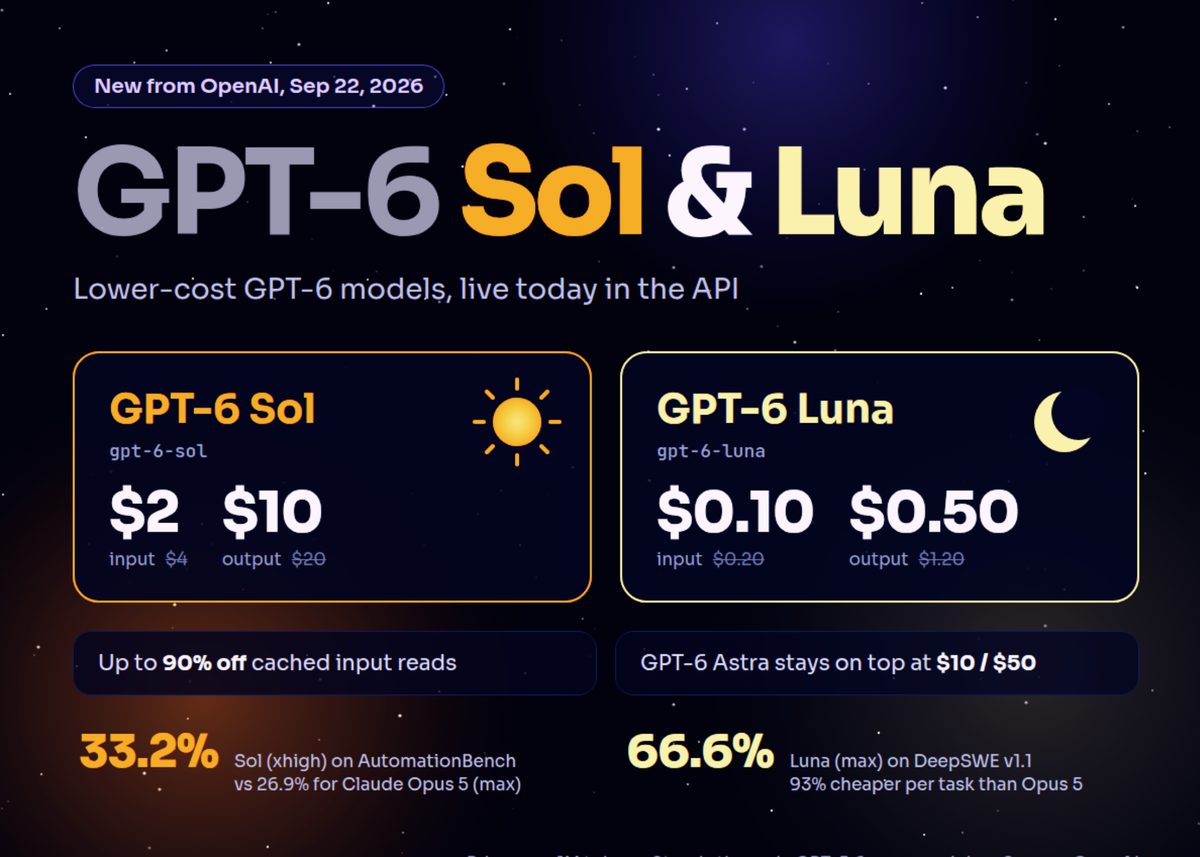
OpenAI published a guide on October 2, 2026, offering practical deployment guidelines for its GPT-6 family of models, including GPT-6 Astra, GPT-6.1 Sol, and GPT-6 Luna. The guide details how developers can balance reasoning effort, speed, and overall expense when running applications in production. To manage latency and API overhead, the documentation highlights techniques such as compaction for long-running context and prompt caching, which according to the company can reduce input token costs by up to 95%.
The model suite spans several specialized options: GPT-6 Astra targets high-level reasoning, GPT-6.1 Sol focuses on complex coding and computer use, and GPT-6 Luna caters to routine task automation at scale. OpenAI emphasizes matching specific workloads to the appropriate model and reasoning level—low, medium, or high—to avoid unnecessary compute expenses.
For engineering teams deploying autonomous workflows, OpenAI recommends automated diagnostic monitoring and async execution for independent tasks. Pre-deployment evaluation metrics should focus on task success rates, overall latency, and cost per successful task execution.
Why it matters
Leverage prompt caching and context compaction to cut GPT-6 API token costs by up to 95% in high-volume production.
Right-size workflows by routing complex reasoning to GPT-6 Astra while sending routine, structured tasks to lower-cost GPT-6 Luna.
Implement async delegation and clear human-in-the-loop boundaries to prevent slow tool calls from bottlenecking agentic pipelines.
Source: openai.com