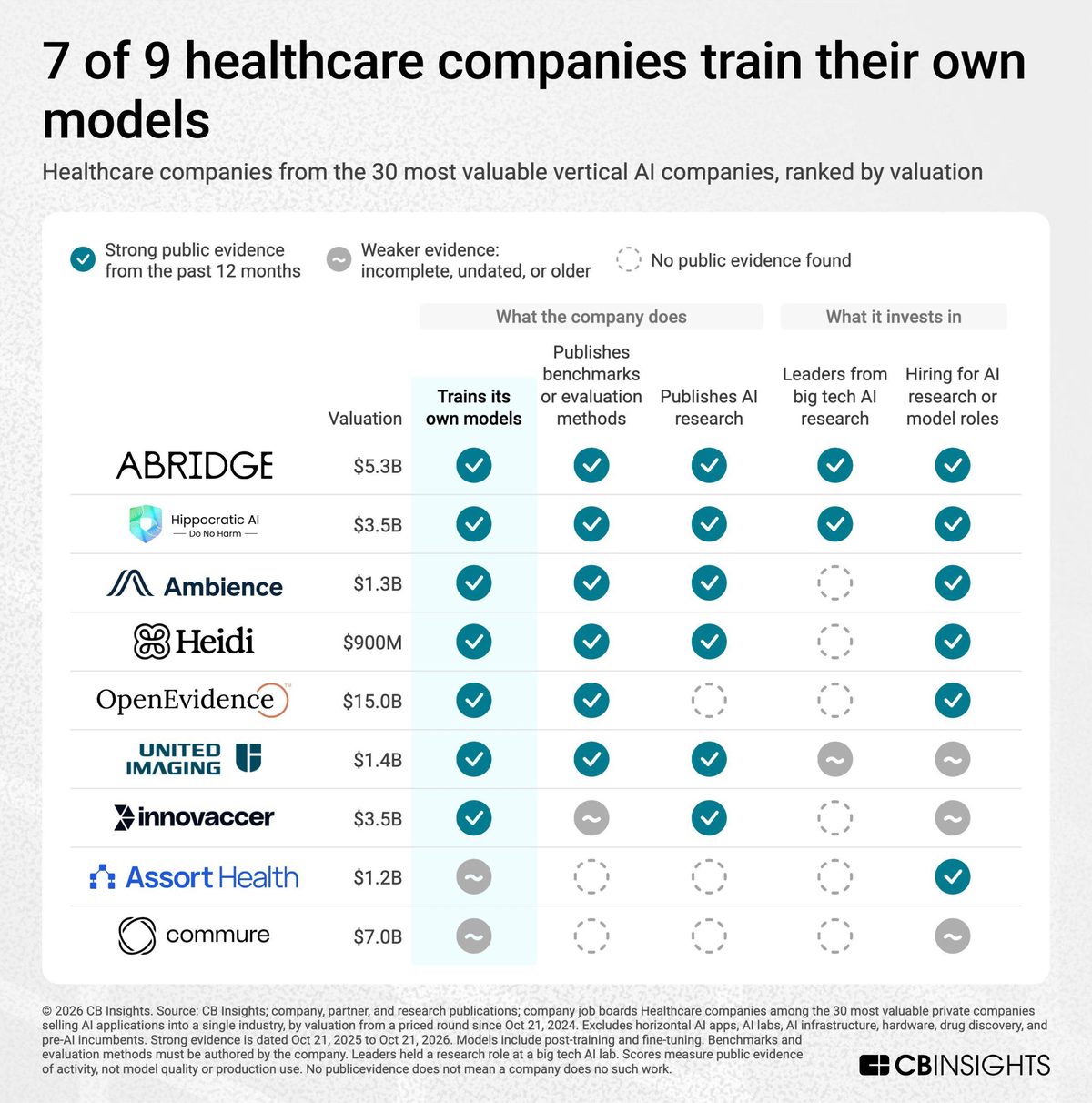
A research analysis by CB Insights reveals that 14 out of the 30 highest-valued vertical AI companies now actively train their own domain-specific models. Rather than relying entirely on third-party foundational APIs, these vertical specialists adapt existing models using specialized domain data—such as clinical dictations or legal precedent—to increase execution accuracy and significantly decrease operational token costs.
Legal AI provider Harvey exemplifies this transition, having recently launched its specialized model, Tenet, built via post-training on Moonshot AI’s Kimi K3 platform. According to Harvey, Tenet operates at less than one-fourth the cost of leading frontier models while placing second overall on its internal legal evaluation benchmark. The cost reduction is vital for vertical vendors managing massive usage surges; Lightspeed reported Harvey’s platform throughput jumped from 1 trillion monthly tokens in January 2026 to 14.6 trillion in June 2026.
To maintain their competitive advantage, vertical AI companies are increasingly adopting research lab behaviors, such as publishing benchmarks, hiring post-training research talent from major tech firms, and acquiring niche evaluation startups. This shift highlights how proprietary evaluation datasets, specialized post-training capabilities, and cost efficiency are becoming essential moats for enterprise vertical applications.
Why it matters
Vertical AI founders must invest in in-house model post-training to protect unit economics as enterprise token consumption scales.
Proprietary domain benchmarks and expert-graded evaluation datasets represent critical defensible moats against general-purpose LLM labs.
Investors should prioritize startups demonstrating vertical research capabilities over simple wrapper architectures.
Source: cbinsights.com